
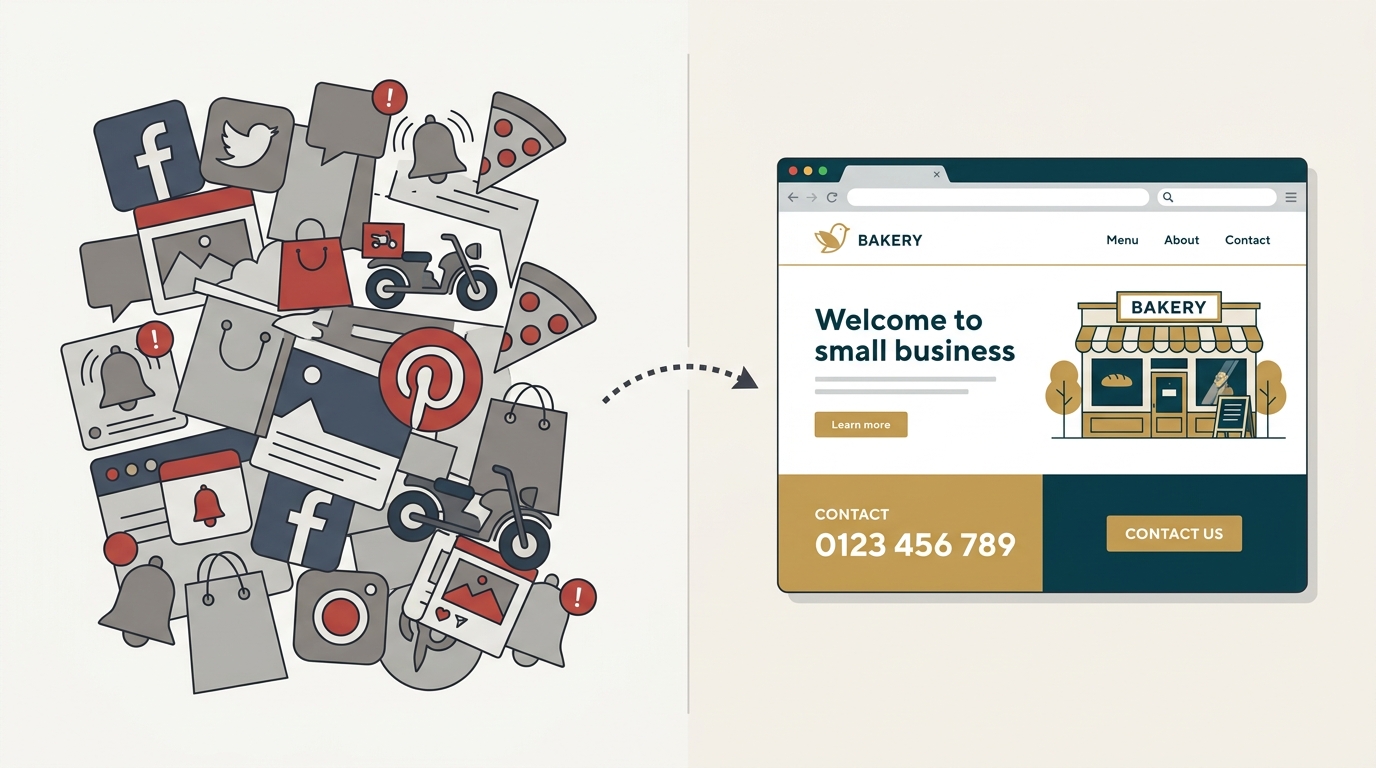
A taqueria owner in San José told me last month that she gets 80% of her orders through DoorDash. She pays 30% commission on every one. That's $18,000 a year going to a company in San Francisco for the privilege of being found online. She doesn't have a website. When I asked why, she said, 'I have an Instagram and a Facebook page. That's enough, right?'
It's not. And if you're asking yourself do I need a website for my small business, the short answer is yes. The longer answer is what the rest of this article is about - with real numbers, real examples, and zero hype.
Do I Need a Website for My Small Business, or Is Social Media Enough?
Here's what social media gives you: a rented audience on someone else's platform. Facebook decides who sees your posts. Instagram changes its algorithm every few months. TikTok might get banned again. You're building on land you don't own.
A website is yours. You control the content, the design, the data, and the customer relationship. Nobody can throttle your reach or charge you 30% for sending a customer your way.
Let's look at real numbers. According to BrightLocal's 2025 consumer survey, 87% of consumers used Google to evaluate a local business in the past year. When someone searches 'best pho near me' or 'emergency plumber Sunnyvale,' Google pulls from websites - not Instagram posts. If you don't have a site, you're invisible in the moment that matters most: when someone is ready to spend money.
The Facebook Page Problem
I'm not saying delete your Facebook page. Keep it. But understand what it can't do:
It can't rank on Google for your services. Try searching 'wedding photographer Fremont' - you'll see websites, Google Business profiles, and Yelp. You won't see Facebook pages. Facebook content lives inside Facebook's walled garden.
It can't take orders or bookings directly. Sure, you can add a 'Book Now' button that links to a third-party service. But that's another middleman, another fee, another place where the customer might drop off.
It can't look professional at 2 AM. When a potential customer is researching HVAC companies at midnight because their heater just died, your Facebook page with a blurry cover photo from 2019 isn't inspiring confidence. A clean, fast website with your services, pricing, and a contact form does.
You don't own your followers. Meta had a major outage in March 2025 that took Facebook and Instagram offline for nearly six hours. Every business that relied solely on those platforms was effectively closed for the day. A website stays up even when Mark Zuckerberg's servers don't.
What a Website Actually Costs in 2026
This is where people get stuck. They Google 'do I need a website for my small business,' see quotes for $5,000-$15,000, and decide Facebook is fine after all.
But here's the reality: a small business website doesn't need to be expensive. You have a few options:
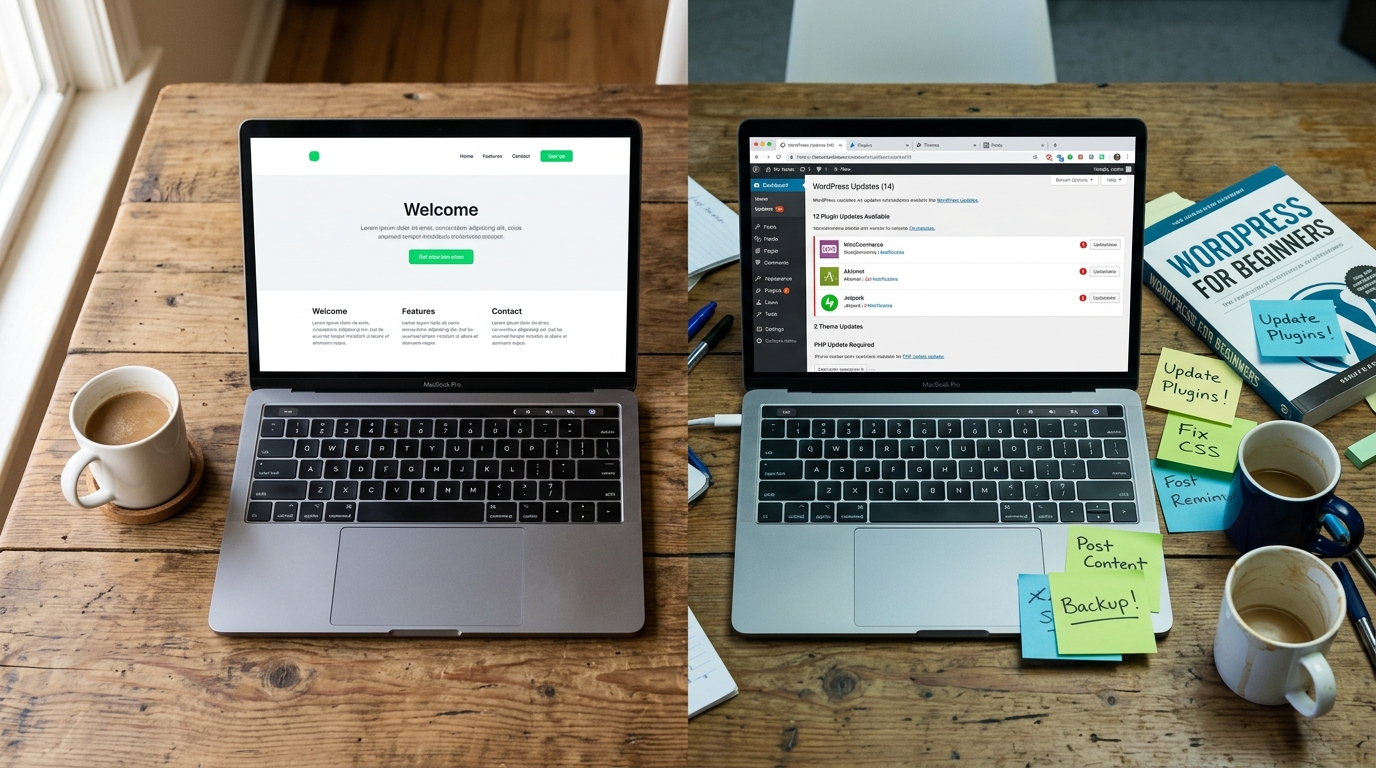
DIY with Squarespace or Wix: $16-$33/month. You'll get a decent-looking site, but you'll spend 20-40 hours building it yourself. If your time is worth $50/hour, that 'cheap' website just cost you $1,000-$2,000 in lost billable hours. And you'll hit walls with customization pretty fast.
WordPress with a theme: $100-$300/year for hosting, plus your time. More flexible, but steeper learning curve. You'll probably need someone to help when something breaks - and something always breaks.
Custom-built by a developer: This is what I do at Autom84You. A clean, fast, mobile-first site for a small business starts at $500. No templates, no bloat, no $200/month subscription fees. You own it outright. I've built sites for restaurants, contractors, salons, and consultants across the Bay Area - you can see examples at autom84you.com/pages/portfolio.php.
The point is: the cost isn't what it was five years ago. The question isn't whether you can afford a website. It's whether you can afford not to have one.
A Real Example: How a Restaurant in Sunnyvale Stopped Losing $1,500/Month
Let me walk through a concrete scenario because abstract advice is useless.
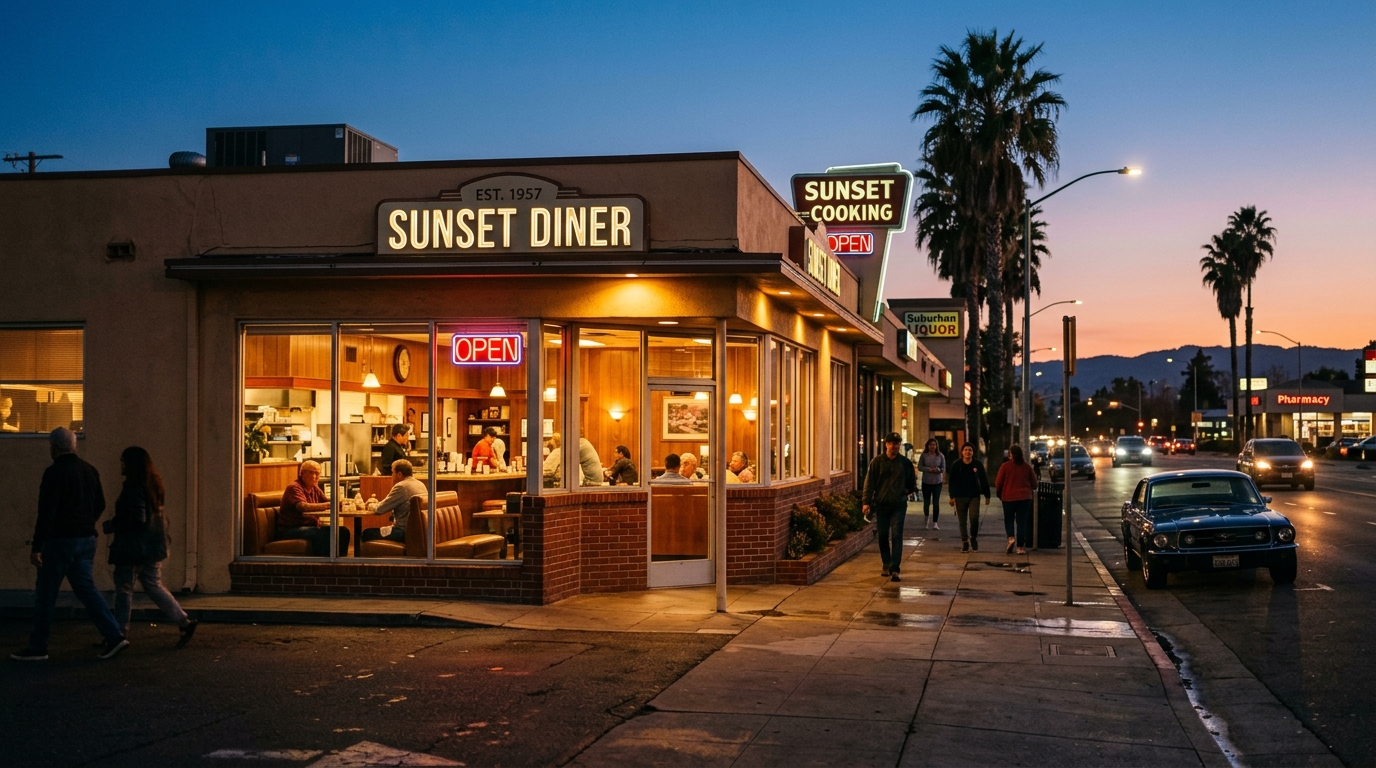
A family-owned Thai restaurant - let's call them Basil & Rice - was running entirely on DoorDash, Uber Eats, and their Facebook page. Monthly revenue through delivery apps: about $8,000. Commission fees: roughly $2,400. Net from delivery: $5,600.
They got a website with an online ordering system. Nothing fancy - menu, online ordering with pickup/delivery options, a Google Maps embed, hours, and a contact form. Total cost: under $800 for the site plus a simple ordering integration.
Within three months, 35% of their delivery app customers switched to ordering directly through the website. Why? Because the restaurant put a card in every delivery bag that said: 'Order direct at basilandrice.com - same food, 15% cheaper.' They could afford the discount because they weren't paying the 30% app commission.
Monthly savings after the shift: roughly $1,500. The website paid for itself in three weeks.
That's not a hypothetical. That's the math. And it applies to almost any service business that's currently paying a middleman to connect with customers who are already looking for them.
But I Already Show Up on Google Maps
Good. Your Google Business Profile is important - arguably the single most important free tool for local businesses. But here's what people miss: Google Business profiles with a linked website rank higher than those without one. Google treats a website as a trust signal. It means you're established. It means there's more information to index. It means you're a real business, not a fly-by-night operation.
Plus, your Google Business profile has limits. You can't write a detailed FAQ about your services. You can't showcase a portfolio of your work. You can't embed a booking calendar or an intake form. You can't publish blog posts that rank for long-tail searches like 'how much does it cost to remodel a kitchen in the Bay Area.'
A website is the hub. Google Business, Facebook, Instagram, Yelp - those are spokes. They point people toward you. But the hub is where conversions happen.
Do I Need a Website for My Small Business If I'm Just Starting Out?
Especially then. When you're new, you have zero reputation. No reviews. No word of mouth. A website gives you instant credibility. It says: this is a real business with real services and a real person behind it.
I've seen solo contractors land $10,000+ jobs because they had a professional website and their competitor - who'd been in business longer - only had a Craigslist ad and a Facebook page. The customer told them directly: 'Your website made you look more legit.'
Perception matters. And a website is the fastest way to look like you take your business seriously, because it shows you actually do.
What Your Website Actually Needs (and What It Doesn't)
If you're a small business, your website needs five things:
1. What you do and where you do it. One clear sentence above the fold. 'We install and repair HVAC systems across Santa Clara County.' Done.
2. How to contact you. Phone number, email, contact form. Make it stupid easy. If someone has to scroll more than twice to find your phone number, you've already lost them.
3. Social proof. Reviews, testimonials, photos of your work. Real ones. Not stock photos of smiling people in hard hats.
4. Mobile-first design. Over 60% of local searches happen on phones. If your site doesn't look good on a 6-inch screen, it might as well not exist.
5. Fast loading speed. If it takes more than 3 seconds to load, 53% of mobile visitors leave. That's not my opinion - that's Google's own data.
What you don't need: a blog you'll never update, a chatbot nobody asked for, parallax scrolling effects, or a 47-page sitemap. Keep it simple. You can always add more later.
That said - if you do want a chatbot that actually works, not the generic 'How can I help you?' popup that everyone ignores, I build custom AI chatbots trained on your actual business data. A Thai restaurant's bot that knows your full menu and can answer 'do you have anything gluten-free?' at 11 PM is genuinely useful. That kind of thing starts at $1,000 through autom84you.com.
The Bottom Line
If you're still wondering do I need a website for my small business, ask yourself this: would you trust a plumber who doesn't have a phone number? A website is the 2026 equivalent. It's not optional anymore - it's the bare minimum signal that you're open for business and serious about it.
You don't need to spend $10,000. You don't need to learn to code. You don't even need to write the content yourself. You just need something real, something fast, and something that belongs to you - not to Meta or Google or DoorDash.
If you've read this far and you're thinking 'yeah, I should probably do this,' shoot me an email at nerd@a84y.com. I'll take a look at what you've got now and tell you straight whether a website would actually move the needle for your specific situation. No pitch, no pressure - just an honest opinion from someone who's built these for 20 years. autom84you.com.

Comments
No comments yet. Be the first to share your thoughts!
Leave a Comment