
The $300-a-Month Question: Is That AI Tool Worth the Price?
A bakery owner in Campbell asked me last month whether she should sign up for an all-in-one AI platform that promised to handle her social media, customer emails, appointment scheduling, and inventory tracking. The price tag: $289 per month. She'd seen the ads everywhere. The landing page looked incredible. The demo video made it seem like she'd never have to think about operations again.
I told her to hold off. Not because the platform was bad - it wasn't - but because the question of whether any ai tool worth the price depends entirely on what you're replacing, not what you're adding.
She was already using Canva (free tier) for social posts, Google Calendar for scheduling, and a $12/month email tool. Total cost: about $12. Total effort: maybe 40 minutes a day. The all-in-one platform would have saved her perhaps 15 minutes daily while costing $277 more per month. That's roughly $18.50 per minute saved. Not great math for a two-person bakery.
What Uber's AI Budget Disaster Tells Small Business Owners
In case you missed it, Uber burned through its entire 2026 AI budget in just four months. The company had encouraged staff to use AI tools as aggressively as possible, even creating internal leaderboards to gamify usage. The result? They've now capped spending at $1,500 per employee per month, and their own COO publicly questioned whether any of it actually produced measurable results.
If a company with Uber's resources can't figure out the ROI on AI spending, it's worth asking: how is a pet groomer in Cupertino or a taco truck in San Jose supposed to evaluate whether an AI tool is worth the price?
The answer isn't complicated, but it requires honesty about what you actually need versus what looks impressive in a product demo.
The All-in-One Trap
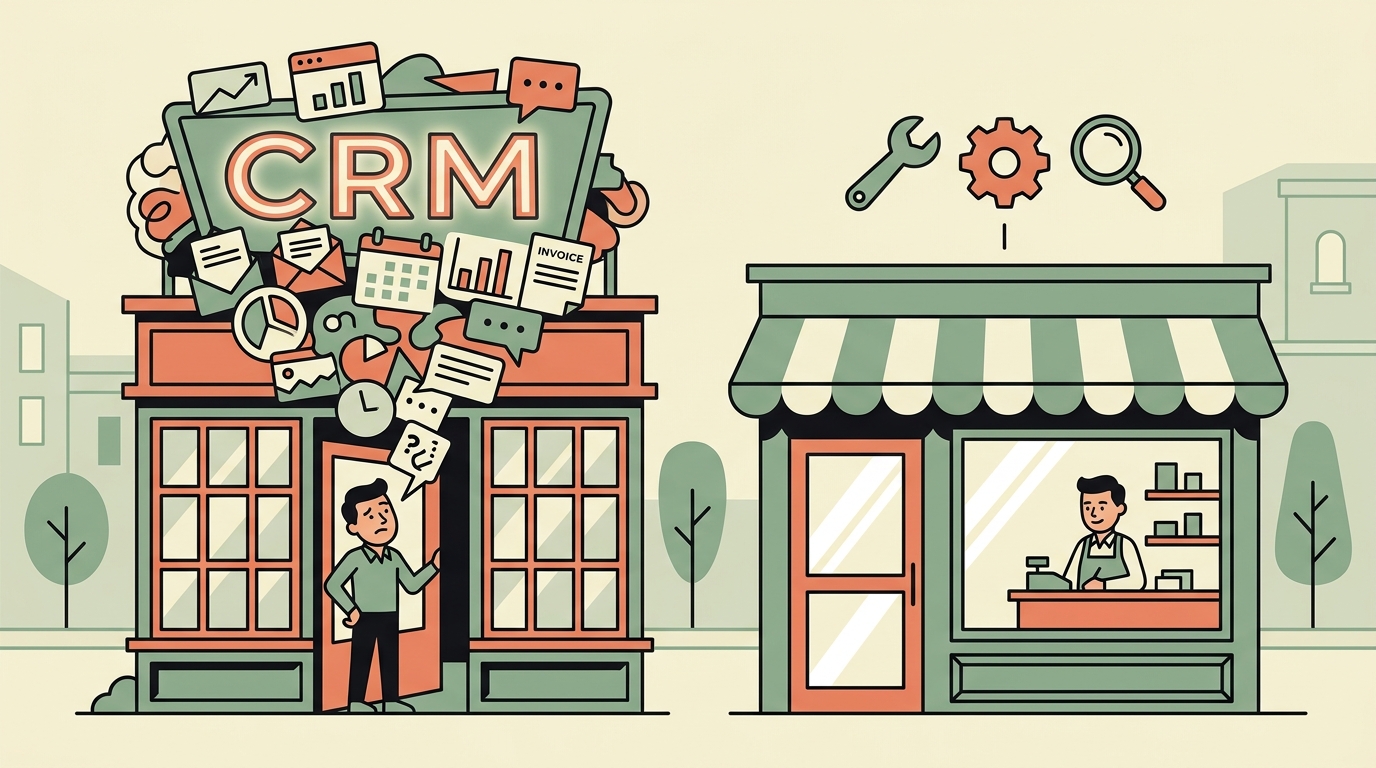
Marcus signs up for the mid-tier plan at $249/month. First two weeks feel amazing. He's clicking through dashboards, generating social captions, setting up automated text reminders. Week three, reality sets in:
- The scheduling tool doesn't sync well with his existing Google Calendar, so he's maintaining two calendars
- The invoicing module is fine but not as good as the $15/month Wave or Square setup he was already using
- The AI-generated marketing copy is generic - it writes the same bland posts any groomer could use
- The CRM is powerful but overkill for a business with 80 regular clients
- The analytics dashboard looks beautiful but doesn't tell him anything he couldn't learn from checking his bank account
Marcus is now paying $249/month for a tool where he actively uses maybe 30% of the features, and the 30% he uses isn't meaningfully better than what he had before.
This is the pattern I see over and over when small business owners ask me to audit their software stack. The all-in-one pitch sounds rational - one login, one bill, everything integrated. In practice, you end up paying for nine tools to use three, and the three you use are each about 70% as good as a dedicated alternative.
How to Actually Decide If an AI Tool Is Worth the Price
I use a dead-simple framework when clients ask me this. Three questions:
1. What specific task takes you more than 30 minutes a day?
Not "what could be improved" - what actually eats your time right now? If the answer is "responding to the same five customer questions over and over," that's a real problem with a specific solution: a trained chatbot or a good FAQ page. You don't need an all-in-one platform for that. You need one focused tool. I build custom AI chatbots starting at $1,000 that are trained on your actual business data - your menu, your services, your pricing, your policies - and they handle exactly this kind of repetitive Q&A without the monthly bloat of a platform you'll barely use.
2. What's the actual dollar value of the time you'd save?
Be brutally honest here. If a tool saves you 20 minutes a day, that's about 10 hours a month. What's your time actually worth per hour in productive work? If you're a solo electrician billing $85/hour, those 10 hours are worth $850 in potential revenue. A $99/month tool that genuinely saves 10 hours? That's an ai tool worth the price, clearly. A $299/month tool that saves you 3 hours? Less clear.
3. Can you get the same result by combining two or three cheaper tools?
This is where most people stop thinking too early. The popular answer for "I need AI help with my business" is usually a platform like Jasper, HubSpot's AI tier, or one of the dozen all-in-one solutions running ads on Instagram right now. The answer nobody markets to you is a combination like this:
- ChatGPT Plus ($20/month) for writing drafts and brainstorming
- Calendly free tier for scheduling
- Mailchimp free tier (up to 500 contacts) for email
- Canva free tier for graphics
Total: $20/month. Does 80% of what a $299 platform does. The missing 20% is usually fancy dashboards and integrations that look great in demos but don't change your revenue.
When the Expensive Option Actually Makes Sense
I'm not here to tell you all premium AI tools are a waste. Some are genuinely an ai tool worth the price. The key indicators:
Pros of a premium all-in-one:
- You have a team of 5+ people who all need access to the same customer data and workflows - at that scale, the integration value is real
- You're spending more than 2 hours a day on tasks the platform demonstrably automates - not theoretically, but provably, with a free trial to back it up
- The platform specializes in your industry (a salon-specific tool like GlossGenius, for instance, is much more useful than a generic business suite because it understands your actual workflow)
Cons that should make you pause:
- The pricing page requires a "contact sales" button instead of showing real numbers - that's a red flag for small business budgets
- The free trial is 7 days or less, which isn't enough time to hit the realistic daily grind where the tool either proves itself or doesn't
- More than half the features listed on the pricing page are things you'd never use - you're subsidizing enterprise functionality
A Real-World Stack That Works
Let me show you what I set up for a family-owned HVAC company in Sunnyvale last year. They were paying $275/month for an all-in-one platform and using about a quarter of it. We replaced it with:
- A custom website with built-in booking forms - one-time cost, no monthly fee beyond hosting (you can see similar builds in my portfolio)
- A trained AI chatbot on their site that answers the same 15 questions their receptionist was fielding daily - cost to build once, fraction of the ongoing platform fee
- Square for invoicing ($0 for the basic tier)
- A simple QR code tracking setup for their truck wraps and door hangers so they could see which marketing actually drove calls
First-year cost including the custom build: less than what they'd have paid for eight months of the all-in-one. Second year onward: close to zero in software costs.
The HVAC company didn't need an ai tool worth the price in the subscription sense. They needed the right tools built once and owned outright.
The Honest Comparison
Here's how the two approaches stack up for a typical small business with under 10 employees:
All-in-one AI platform (e.g., HubSpot Starter AI, Vendasta, GoHighLevel): $97-$349/month. Lots of features. Ongoing cost forever. You're renting. If you leave, you lose your workflows and sometimes your data export is painful. Best for: businesses that are scaling fast and need team-wide access to shared systems.
Curated stack of focused tools + custom builds where it matters: $0-$50/month in software, plus one-time costs for custom work. You own everything. Each tool does its one job well. Best for: solo operators and small teams where the owner is the main user.
Neither approach is universally right. But for most of the small businesses I work with - restaurants, contractors, fitness studios, cleaning services - the curated stack wins on cost and simplicity every single time.
What to Do This Week
Open your credit card statement. Search for every software subscription you're paying for. Write down three columns: what it is, what you actually use it for, and what it costs. I guarantee at least one line item is a tool you signed up for, used heavily for two weeks, and now barely touch.
That's the tool to cancel first. Not because AI tools aren't useful - some are - but because the only ai tool worth the price is one you use daily to solve a problem that actually costs you money or time.
If you want a second opinion on your specific setup - what to keep, what to cut, what to build custom - send me your list at nerd@a84y.com. I'll tell you straight whether the popular choice fits your situation or whether there's a simpler path. No pitch, just an honest take from someone who's built these stacks for Bay Area small businesses for over two decades. More about what I do at autom84you.com.




Comments
No comments yet. Be the first to share your thoughts!
Leave a Comment