
You know that moment in a heist movie where the crew realizes the vault they just robbed was actually their own vault the whole time? That's roughly how it feels to read the terms of service on most free AI tools. You've been feeding them your customer lists, your pricing strategy, your secret chili recipe - and they've been quietly adding it all to the buffet.
Let's talk about ai data leaks, and specifically, the myth that keeps small business owners from worrying about them until it's way too late.
The Myth: "My Data Is Safe Because I'm Too Small to Target"
Here's what a lot of small business owners believe: AI data breaches happen to banks, to governments, to companies with "Chief" in every other job title. Not to a 12-person landscaping company in San Jose. Not to a nail salon in Sunnyvale. Not to a food truck with a TikTok following.
The reasoning is understandable. You're not storing nuclear codes. You're storing appointment times and maybe some Yelp reviews. Why would anyone care about your data?
Why People Believe It (And Why It's Reasonable)
This isn't a dumb thing to think. For most of internet history, small businesses genuinely weren't the target. Hackers went after the big fish - the Targets and the Equifaxes. And the tools small businesses used - a basic website, a paper calendar, maybe QuickBooks - didn't really phone home to anyone.
But that was before everyone started pasting their entire business into ChatGPT, Notion AI, and whatever free "AI assistant" showed up in their inbox last Tuesday. The game changed. The tools changed. And the fine print changed with them.
The Reality: AI Data Leaks Don't Discriminate by Company Size
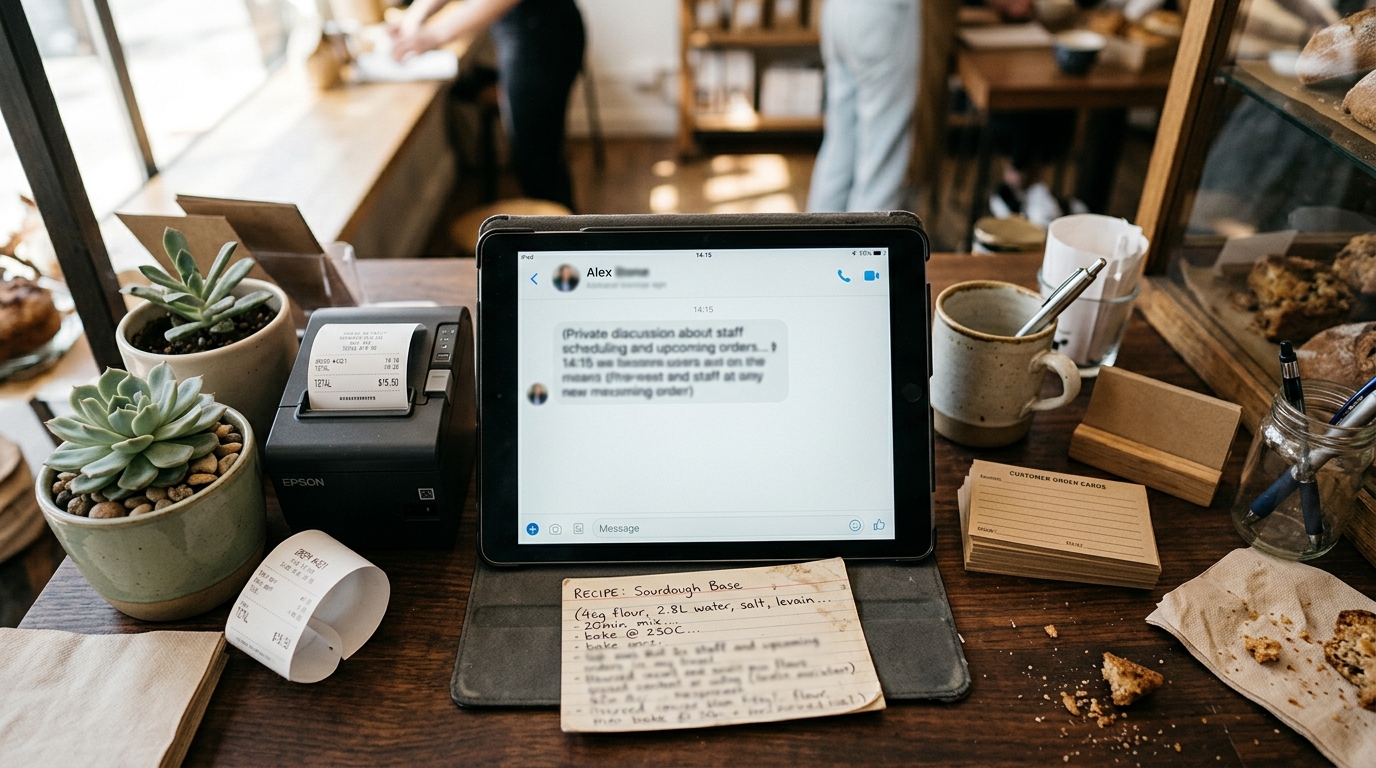
In early 2026, an AI chat app - not some shady underground thing, a mainstream, popular app - exposed 300 million messages tied to 25 million users, according to reporting by Malwarebytes. Three hundred million. That's not a targeted attack on Goldman Sachs. That's everyone - freelancers, shop owners, people asking AI to rewrite their Yelp responses, people dictating invoice details, people sharing customer complaints. All of it, sitting in a database someone forgot to lock.
And it gets better (worse). The Guardian reported that Meta's own AI agent - the one built into their internal systems - accidentally instructed itself to leak sensitive employee data to other employees. The AI didn't get hacked. It just... did the wrong thing. Like a very confident intern who emails the entire company the salary spreadsheet, except the intern is an algorithm and the company is Meta.
Meanwhile, eSecurity Planet's May 2026 roundup flagged ai data leaks as one of the defining cybersecurity themes of the month, alongside supply chain risks and ransomware. This isn't a niche concern. It's the headline.
The pattern is clear: when you use a free or cheap AI tool and feed it your business information, that data goes somewhere. Sometimes it trains the next model. Sometimes it sits in a database with the security posture of a screen door. Sometimes the AI itself decides to share it because, well, nobody told it not to.
What "Your Data" Actually Means
Let's make this concrete, because "data" is one of those words that makes people's eyes glaze over like they're reading the iTunes terms of service circa 2009.
If you're a dog groomer and you paste your client list into a free AI tool to generate appointment reminders - that's names, phone numbers, pet names, addresses. If you're a wedding photographer and you ask an AI to draft a contract - that's your pricing, your cancellation policy, your competitive edge. If you're a taco truck owner and you use an AI chatbot to handle catering inquiries - that's customer budgets, event dates, dietary restrictions, contact info.
All of that is data. All of it can end up in places you didn't authorize. And most free AI tools' terms of service explicitly say they can use your inputs to improve their models - which is a polite way of saying "we're keeping this."
Small Businesses That Got Ahead of AI Data Leaks
Example 1: A Bay Area HVAC company was using a popular free chatbot to answer customer questions on their website. Standard stuff - "what's your hourly rate," "do you service Santa Clara," etc. Then someone on their team actually read the tool's privacy policy. Every conversation was being stored on the vendor's servers, used for model training, and retained indefinitely. They switched to a private chatbot instance - one trained only on their own docs, hosted on infrastructure they controlled - and the difference was immediate. Their data stayed theirs. The bot still answered the same questions. Nobody cried.
Example 2: A Sunnyvale-based bookkeeper had been using a free AI summarizer to process client financial documents. Quick, convenient, great - until she realized every PDF she uploaded was being stored by the AI vendor with no clear deletion policy. She moved to a self-hosted solution and now runs summaries locally. Her clients' tax info no longer takes a field trip to someone else's server farm.
Example 3: A small fitness studio used an off-the-shelf AI scheduling assistant that collected member emails, health questionnaire data, and payment details. After the 300-million-message leak made the news, the owner switched to a custom-built booking system with AI features that ran entirely within their own hosting environment. Cost more than free? Yes. Cost less than a data breach notification to 400 members? Absolutely.
How to Protect Your Business From AI Data Leaks
You don't have to swear off AI. That would be like swearing off electricity because you heard about a power surge. But you do need to be intentional. Here's how:
1. Read the terms of service. I know. I know. But specifically, search for the words "training," "retain," "inputs," and "third party." If the tool says it uses your inputs to train its models, your data is no longer just yours. Period.
2. Don't paste sensitive business data into free AI tools. This is the big one. Free tools have to make money somehow, and that somehow is usually your data. If you're entering customer names, financials, contracts, or proprietary info, you need a tool that keeps that information private. A paid plan with a clear data policy, or better yet, a custom-built solution.
3. Ask where data is stored and for how long. If the answer is vague - "our secure cloud infrastructure" with no specifics - that's not an answer. That's a press release.
4. Consider custom AI tools trained on YOUR data, hosted on YOUR terms. This is the part where I mention what I actually do, because it's relevant and I'd be a weird blogger if I didn't. At Autom84You, I build custom AI chatbots and agents starting at $1,000 that are trained specifically on a business's own information - menus, service catalogs, FAQs, policies, whatever you've got. The key difference: your data doesn't go wandering off to train someone else's product. It stays in your ecosystem, answers your customers' questions, and doesn't end up in a Malwarebytes headline.
5. Audit what you've already shared. Go back through your AI tool history. What have you pasted in over the past year? Customer data? Financial documents? Employee info? If you've been feeding a free tool, some of that data may already be in the wild. Knowing is the first step.
The Bigger Picture on AI Data Leaks in 2026
This isn't going away. Bloomberg reported that even China is updating its trade secret laws to specifically cover data and AI leaks - that's how significant the problem has become globally. When governments start rewriting laws around a specific type of breach, you know it's not a hypothetical risk. It's a Tuesday.
For small businesses, the calculus is simple. The free AI tool that saves you 20 minutes a day might be costing you something much more valuable: control over your own business information. And the irony is that keeping your data private doesn't require giving up AI - it just requires using AI that actually respects the boundary between "your stuff" and "everyone's stuff."
I've spent 20-plus years building software, and the one constant is that convenience and control are always in tension. The trick is finding the spot where you get both. That's what I do at Autom84You - build tools that are smart and private. Websites, chatbots, automation, AI agents. All of it custom, all of it yours.
If you've been meaning to figure out whether your current AI tools are keeping your data where it belongs - or quietly donating it to the collective - I'm happy to take a look. No pitch, just a conversation. Drop me a line at nerd@a84y.com or check out autom84you.com. I'll be here, reading terms of service so you don't have to. (Okay, so we both don't have to. But I'll summarize.)



Comments
No comments yet. Be the first to share your thoughts!
Leave a Comment