
I have a confession. I'm still paying $12.99 a month for a meditation app I used exactly twice. Both times were stressful - because I was trying to figure out how to cancel the meditation app.
If you run a small business, you probably have your own version of this. Maybe it's that project management tool you signed up for during a "productive Monday" that turned into a "regular Monday" by lunch. Maybe it's three different cloud storage plans because you forgot which one had your tax documents. The subscription vs one time software debate isn't abstract for you. It's line items on a bank statement that make you wince every month.
So let's talk about it. Not the marketing version where everything is "flexible" and "scalable." The real version, where a dog groomer in San Jose is trying to figure out if paying $49 a month forever for scheduling software makes more sense than buying something once for $199.
The Subscription vs One Time Software Math Nobody Does
Here's the thing about subscriptions: they're designed so you don't do the math. That's the whole point. $15 a month sounds like nothing. It's a burrito. Who can't afford a burrito?
But burritos don't auto-renew for three years. At $15/month, you've spent $540 over three years. The one-time purchase version of the same tool? Often $150-$300. You'd have paid for it twice over and still be chewing.
Adobe Creative Cloud runs about $55/month for all apps. That's $660 a year. Affinity's entire suite - photo editing, design, publishing - is a one-time purchase of $170. Even Microsoft is loosening its grip on forced updates, letting Windows users pause things indefinitely now. The vibe is shifting. People are tired of being on the hook.
For a wedding photographer in the Bay Area, that Adobe bill is real money. Over five years, it's $3,300 versus $170. And Affinity does 90% of what Photoshop does for the work most small businesses actually need.
When Subscription vs One Time Software Actually Favors the Subscription
I'm not here to tell you subscriptions are a scam. Some of them genuinely earn the monthly fee. The key is whether the tool changes frequently enough that you need the updates.
Accounting software like QuickBooks Online? Subscription makes sense. Tax laws change. Bank integrations update. You want someone else worrying about that. Same with security tools - antivirus, password managers. Those need constant updates to stay useful. An antivirus from 2023 is basically a screen decoration at this point.
But your invoicing app? Your appointment scheduler? Your basic image editor? These tools don't evolve fast enough to justify perpetual payments. A taco truck owner in Sunnyvale doesn't need their POS software to get a major update every quarter. They need it to work.
The One-Time Purchase Renaissance
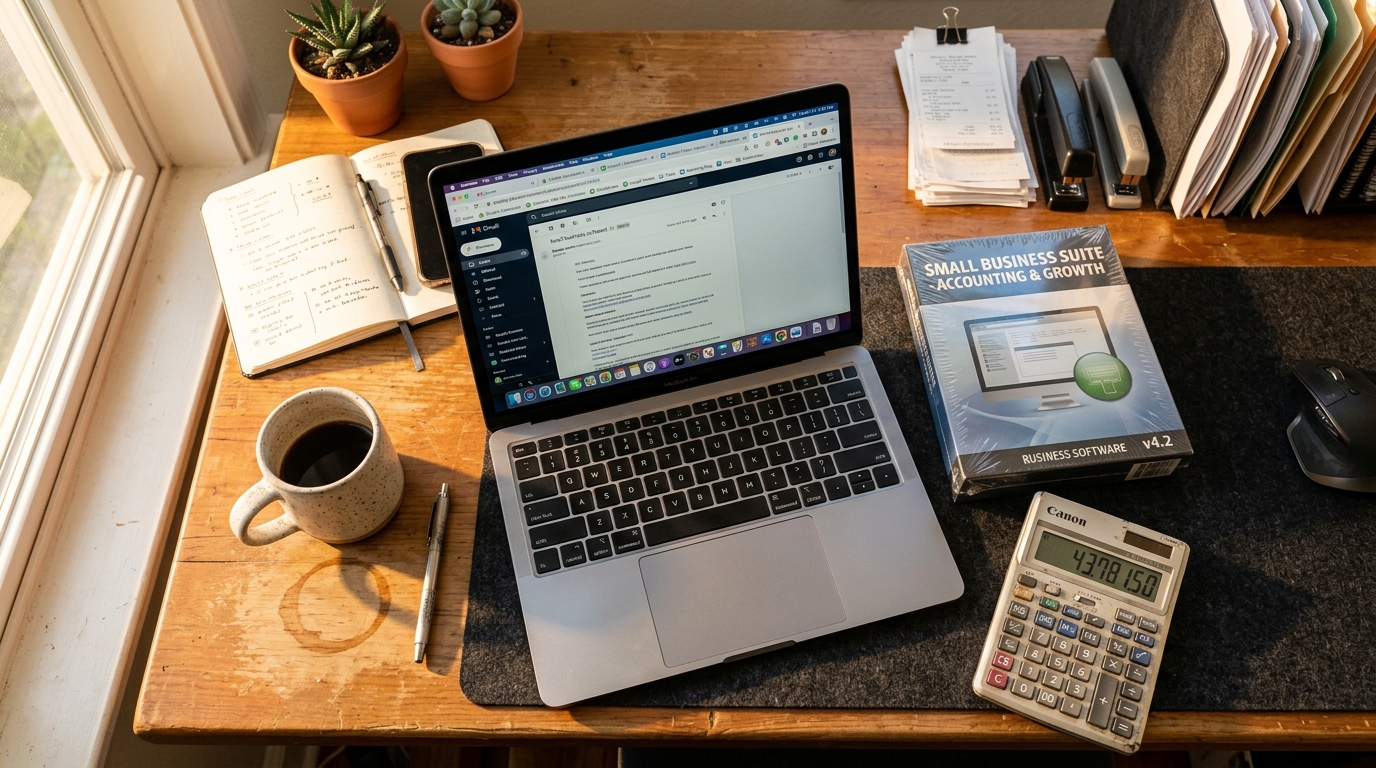
And it's working. Tools like Affinity (design), Davinci Resolve (video editing), iA Writer (writing), and Paw/RapidAPI (API testing) all offer one-time purchases. Some indie developers are building entire businesses around the idea that you pay once, you own it, done.
For small businesses, this matters more than you'd think. An HVAC company running three software subscriptions at $30-50 each is spending $1,000-$1,800 a year on tools. Switch two of those to one-time purchases and you've freed up real budget - maybe enough to finally get that website rebuilt or add an AI chatbot that actually answers your customers' questions instead of playing phone tag until everyone gives up.
The "But What About Updates?" Question
This is the subscription industry's favorite card. "But you won't get updates!" As if every update is a gift and not, frequently, someone rearranging your menu options for no reason.
Most one-time purchase software still gets bug fixes and security patches. What you don't get is the major version upgrade - which is fine, because most major version upgrades are the software equivalent of your landlord repainting the apartment and raising the rent. New icon, same spreadsheet.
When a genuinely useful new version drops, you can choose to pay for the upgrade. Affinity charged $170 for version 2 - and people who owned version 1 got a discount. Compare that to Adobe, where you've been paying $660 a year whether they improved anything or not. The subscription vs one time software calculation here is simple: one model respects your decision-making, the other removes it.
A Decision Framework for Non-Nerds
Here's how I think about it when I'm building tools for clients at Autom84You:
Go subscription if:
- The tool connects to external systems that change often (banking, taxes, social media APIs)
- Security is the core function (antivirus, password management)
- You need real-time collaboration with a team that's actually collaborating (not just "we have seats")
- The vendor has a genuine track record of shipping useful updates, not just redesigning the settings page
Go one-time purchase if:
- The tool does a specific job that hasn't fundamentally changed in years (editing photos, writing documents, managing local files)
- You're the only user or a very small team
- You've used the subscription version and realized you use maybe 20% of the features
- You're tired of the app asking you to "explore what's new" when you just want to make an invoice
Tesla, and the Subscription Creep Nobody Asked For
It's not just software anymore. Tesla recently announced they're shifting Full Self-Driving to a subscription-only model. You can't buy the feature outright anymore. This is a car. Imagine buying a car and then paying monthly for the steering to work properly.
This is where subscription vs one time software stops being a budget debate and starts being a philosophy question. When do you own the thing you paid for? When does "access" replace "ownership" in a way that actually hurts you?
For small businesses, the answer is practical: every subscription is a dependency. Every monthly payment is a decision someone else can change. Adobe raised prices. Salesforce raised prices. Your landlord raised your rent and at least you can move apartments. Try migrating ten years of client data out of a SaaS tool that just doubled its rates.
What I Actually Do About This
When I build custom tools for small businesses - websites, chatbots, automation - I try to minimize recurring dependencies. A custom website from Autom84You costs $500-$2,000 once, not $29/month forever on Squarespace. Over three years, that Squarespace site costs $1,044. Over five years, $1,740. The custom site? You own it. You move it wherever you want. Nobody emails you about "exciting changes to your plan."
Same with AI chatbots. Some vendors charge $99-$300 a month. I build custom ones starting at $1,000 - trained on your actual business data, running on your infrastructure, with no monthly surprise. Not every client needs that, but the ones who've done the math tend to prefer it.
The subscription vs one time software debate comes down to one honest question: is this tool earning its monthly fee, or is it just... there? Like my meditation app. Silently renewing. Quietly judging me for not meditating.
At least I'm finally calm about it.
If you want to figure out which of your software subscriptions deserve to stay and which ones are just expensive screensavers - or if you want something built once that you actually own - drop a line at nerd@a84y.com or check out autom84you.com. I promise not to charge you monthly for the advice.


Comments
No comments yet. Be the first to share your thoughts!
Leave a Comment