
She Was Running a $2M Distribution Business on Sticky Notes
A food distributor in San Jose called me last fall. She supplies produce to 40+ restaurants across the South Bay. Her 'inventory system' was a combination of a whiteboard, three spiral notebooks, and a shared Google Sheet that her warehouse guy refused to update because - his words - 'the columns keep moving.'
She was losing about $3,200 a month in spoiled inventory she didn't know she had, and another $1,500 in orders she fulfilled late because nobody could tell what was actually in stock. That's $56,400 a year in preventable losses. For context, her annual profit margin was around $180K.
She didn't need SAP. She didn't need Oracle NetSuite at $999/month. She needed a supply chain management system PHP could handle - something custom, something that matched how her business actually works, not how some enterprise software company thinks it should work.
So I built her one.
Why a Supply Chain Management System in PHP Makes Sense for Small Operations
Before you roll your eyes - yes, PHP. Not Python, not Node, not whatever framework hit the front page of Hacker News this week. Here's why.
PHP runs on virtually any $5/month hosting plan. Her existing website was already on a LAMP stack. Her part-time IT person (her nephew) knew enough PHP to not break things. And PHP 8.2+ is genuinely fast - we're not talking about the PHP of 2009 anymore.
The alternatives were grim. I priced out five off-the-shelf options for her:
- Sortly - $49/month, decent for simple inventory but no supplier management or route tracking. Too basic.
- inFlow - $110/month for the mid tier. Closer, but the reporting was rigid and couldn't handle her custom delivery zones.
- Fishbowl - $329/month. Powerful, but designed for manufacturers. Half the features were irrelevant, and the onboarding alone would've taken weeks.
A custom supply chain management system PHP application, tailored to her exact workflow, cost her $4,200 to build and $25/month to host. Break-even in under two months against those monthly SaaS fees - and that's before counting the $56K in annual losses it fixed.
What the System Actually Does
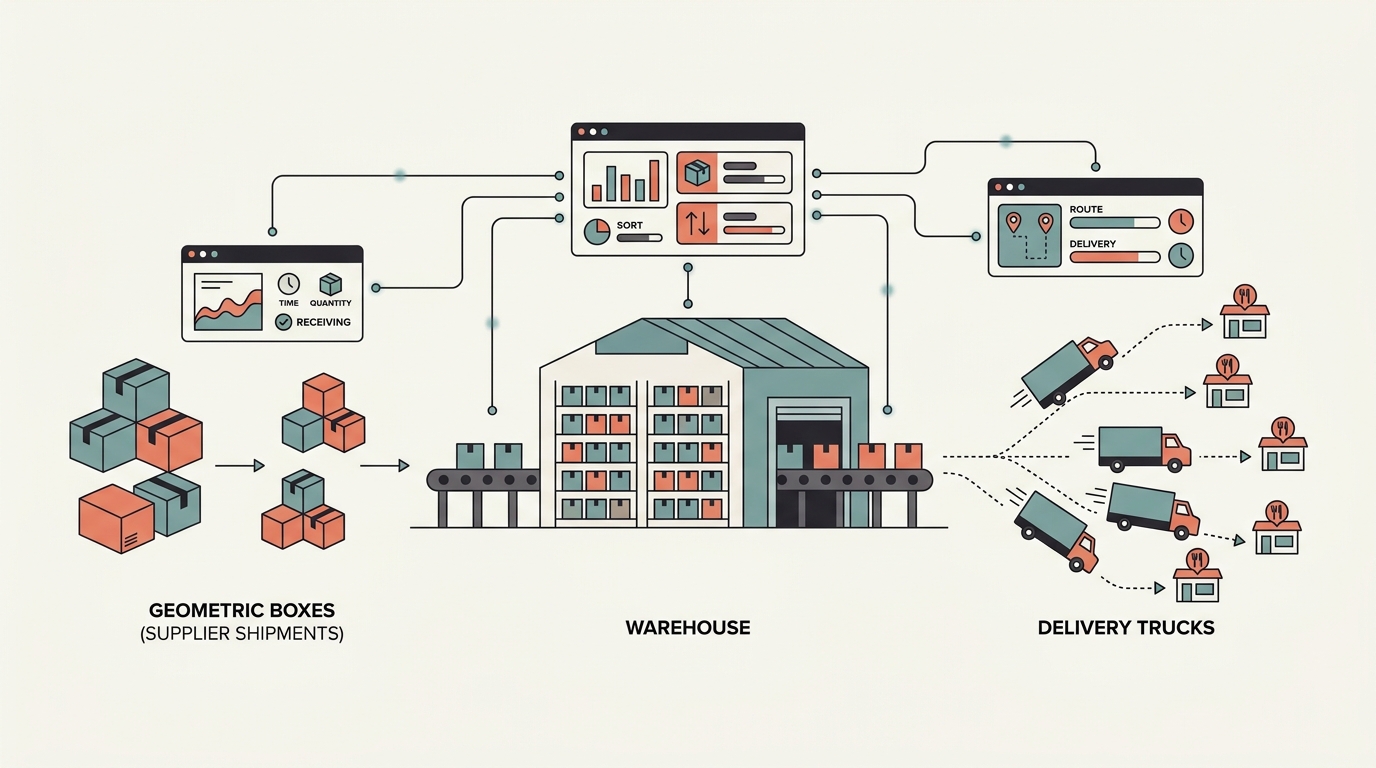
No buzzwords. Here's what it does in plain terms:
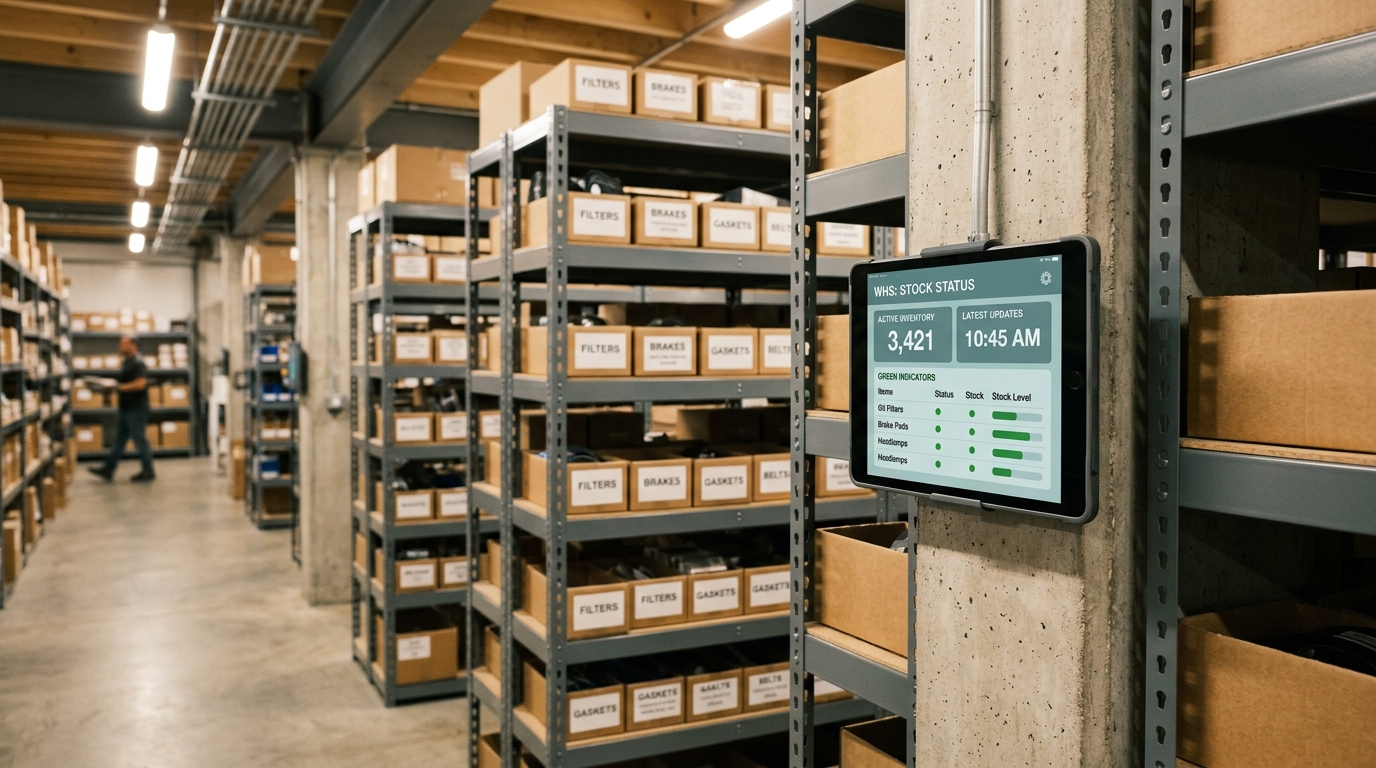
Inventory tracking with expiration dates. Every item that enters the warehouse gets scanned (barcode reader, $35 on Amazon). The system logs what it is, when it arrived, and when it expires. A dashboard shows what needs to ship first. Her spoilage dropped 80% in the first month.
Purchase orders to suppliers. She has 12 regular suppliers. The system tracks what she's ordered, what's been delivered, what's outstanding. When stock drops below a threshold she sets, it flags it. She used to forget to reorder avocados at least once a month. (Her restaurant clients noticed.)
Delivery scheduling. Her 40 restaurant clients each have preferred delivery windows. The system groups orders by delivery zone - she has six zones across the South Bay - and generates a daily route sheet. Her drivers went from averaging 38 stops a day down to 32, same volume, less fuel, fewer missed windows.
Client portal. Each restaurant logs in, sees their order history, places new orders, and can flag issues. Before this, everything was phone calls and texts. She was spending two hours a day just on order intake. Now it's about 15 minutes reviewing what came in overnight.
The Tech Stack Behind This Supply Chain Management System PHP Build
For the developers reading this, here's what's under the hood:
- PHP 8.2 with Laravel 10 - because I wanted Eloquent ORM for the relational data and Laravel's queue system for background jobs (expiration alerts, low-stock notifications)
- MySQL 8.0 - relational data is relational data. Products, suppliers, orders, deliveries, clients. This isn't a NoSQL problem.
- Alpine.js + Livewire on the front end - reactive enough for the dashboard without the overhead of a full SPA
- Hosted on a $25/month DigitalOcean droplet - 2 vCPUs, 4GB RAM. More than enough for her volume.
Total codebase is about 8,000 lines. Not small, not huge. Took me roughly 56 hours across three weeks. At my rate of $75/hour for custom builds, the math checks out to that $4,200 figure.
Honest Pros and Cons
I'm not going to pretend this is perfect for everyone.
Pros:
- Fits like a glove. Every screen, every workflow, every report matches how she actually runs her business. No adapting her process to fit the software.
- No monthly ransom. She owns the code. Hosting is $25/month. If she wants to switch developers, she can hand the codebase to anyone who knows PHP.
- Fast to modify. When she added a seventh delivery zone in January, I updated the routing logic in 45 minutes. Try getting Fishbowl to do that.
Cons:
- Upfront cost is real. $4,200 isn't pocket change for a small distributor. SaaS spreads the pain monthly - custom development asks you to pay before you see results.
- You need someone to maintain it. Software isn't a set-and-forget thing. She has a maintenance agreement with me for 2 hours/month ($150). Without that, bugs would pile up.
- No mobile app (yet). The drivers use the web app on their phones, which works, but a native app with offline capability would be better for spotty warehouse WiFi.
Supply Chain Management System PHP vs. Off-the-Shelf: When Custom Wins
Custom doesn't always win. If you're a single-location retailer tracking 200 SKUs, Sortly at $49/month is probably fine. If you're a manufacturer with complex BOM requirements, Fishbowl or NetSuite might genuinely be worth the price.
But custom wins when:
- Your workflow is specific enough that off-the-shelf tools force you to change how you operate
- You've outgrown spreadsheets but aren't big enough to justify $300+/month enterprise software
- You need integrations with systems you already have (her POS, her accounting software, her existing website)
- You want to own your data and your code, full stop
The recent Packagist supply chain attack is also worth mentioning here - when you build custom, you control your dependencies. You're not blindly pulling in packages from a public repo without auditing them. Security matters, especially when you're handling client data and financial records.
What This Looks Like for Other Business Types
I used the food distributor as the example because that's the project I just finished. But a supply chain management system PHP application works for a surprising range of small operations:
A screen printing shop in Fremont - tracking blank inventory (shirts, hoodies, hats by size/color), ink supplies, order fulfillment status, and shipping. Their current system is literally a folder of printed emails.
A small cosmetics brand selling DTC and wholesale - managing raw ingredients, batch production, expiration tracking (FDA requires it), and splitting inventory between their Shopify store and their wholesale accounts.
A florist with three locations - perishable inventory across multiple sites, supplier orders that change daily based on season and availability, and delivery routing for events.
The pattern is the same: product comes in, gets tracked, gets allocated, goes out. The details are different enough that generic software always leaves gaps.
What I'd Do Differently Next Time
If I built this supply chain management system PHP project again from scratch:
I'd start with the mobile experience. We built desktop-first and made it responsive later. Should've been the other way around - the warehouse staff and drivers are on their phones 90% of the time.
I'd add barcode generation from day one instead of bolting it on in week two. Custom barcodes for internal SKUs saved her team a ton of confusion with supplier-side labeling inconsistencies.
And I'd build the reporting module with export-to-QuickBooks baked in from the start. We added it later, and retrofitting financial integrations is never fun.
The Real Question
If you're running any kind of distribution, wholesale, or inventory-heavy operation and you're duct-taping it together with spreadsheets and memory - the question isn't whether you need a system. You already know you do. The question is whether you need a $300/month subscription to software that's 60% features you'll never touch, or a custom build that does exactly what you need and nothing else.
I've built supply chain management system PHP applications, custom AI tools, e-commerce platforms, and CRM systems for small businesses across the Bay Area for 20+ years. Every one of them started with the same conversation: 'Here's what I'm doing now, and here's where it's falling apart.'
If that sounds familiar, send me a note at nerd@a84y.com. I'll tell you whether custom makes sense for your situation or whether an off-the-shelf tool would actually serve you better. No pitch, just an honest take from someone who's seen both sides.


Comments
No comments yet. Be the first to share your thoughts!
Leave a Comment