
A client asked me last week why their AI bill tripled even though they barely used ChatGPT more than the previous month. We checked their setup together. Gmail connector. Google Drive connector. Notion connector. Slack connector. Calendar connector. Every time they typed a one-sentence question, their AI was quietly reading through 40 emails, two PDFs, a spreadsheet, and three Slack threads before answering.
They thought they were using AI smart. They were actually paying AI to read a novel every time they needed a haiku.
This is the connector trap, and almost nobody is talking about it.
The pitch vs. the reality
Every major AI tool — ChatGPT, Claude, Codex, Cowork, the rest of them — is racing to add connectors. Plug in Gmail. Plug in your Drive. Plug in your CRM, your calendar, your Slack, your code repo. The marketing pitch is seamless: your AI becomes a magical assistant that just knows your stuff.
The pitch is honest. The part that gets left out is the economics.
When you ask a connector-enabled AI a question, it doesn't magically know the answer. It pulls in raw data — whole documents, entire email threads, full database rows — and reads them into its context window to figure out what you need. That 47-page proposal you connected from Drive? The AI reads the whole thing to answer "when is the deadline?". Those 200 emails from your client? All scanned. All counted.
And every word the AI reads costs you.
Tokens are how AI charges you, and they add up fast
If you've never thought about tokens, here's the short version: tokens are little pieces of words — roughly three-quarters of a word on average. Every AI charges you for them in both directions. You pay for what you send the AI and what it sends back. "How's the weather?" is maybe four tokens. A 20-page PDF is somewhere around 10,000 tokens.
On a paid plan, there's usually a monthly cap. On API usage, you pay per million tokens. Either way, when a connector dumps a whole document into every query, your budget burns silently in the background. You see the ceiling hit and you can't figure out why because from your end, you only typed one sentence.
The part that stings: most of those tokens were paying AI to read things that had nothing to do with your question.
The smarter pattern: filter first, then ask
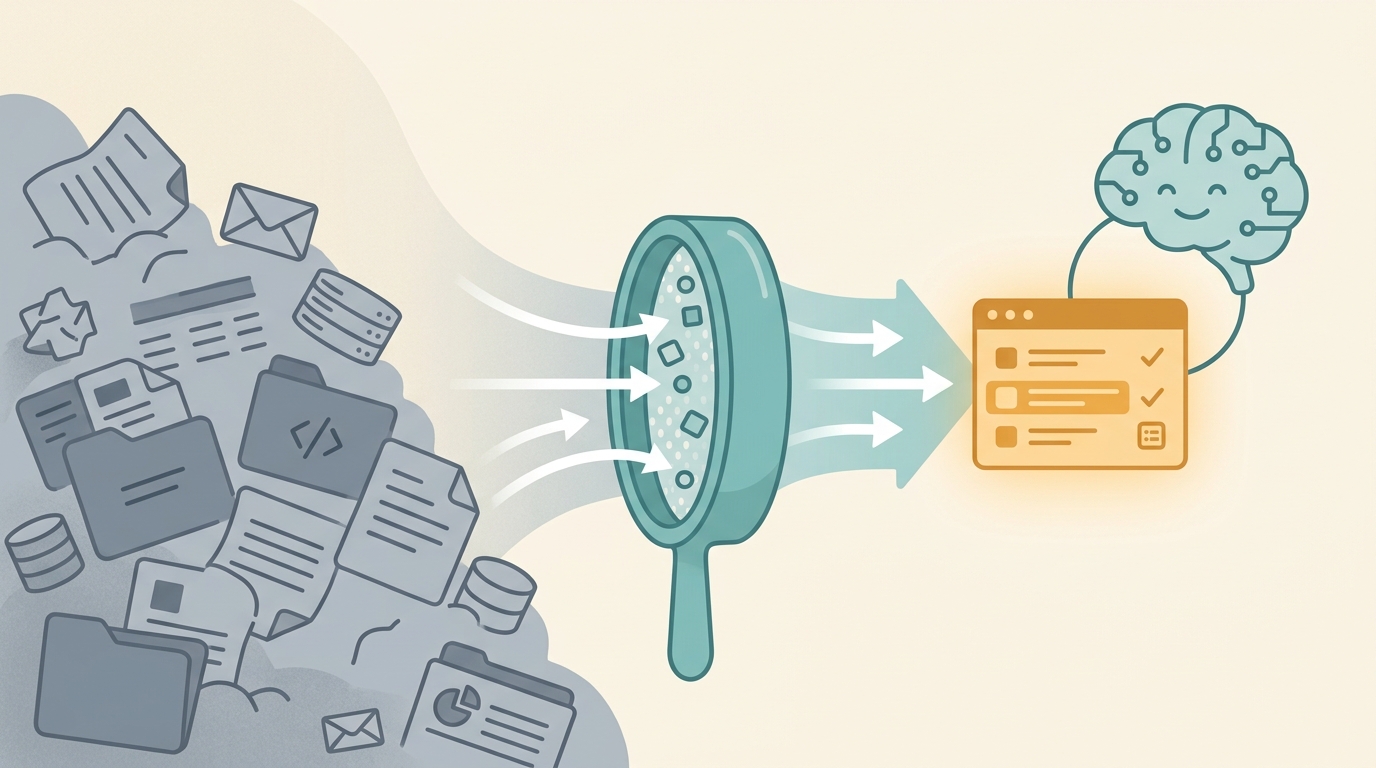
Here's what almost nobody tells you. You don't have to hand AI the raw data. You can build a small program — Python is perfect for this, but any language works — that sits between your data sources and the AI. It does the boring work first. Then it hands AI a clean, surgical payload.
Think of it like making a sandwich for a friend versus sending them into the grocery store. Same end result. Wildly different effort.
A tiny filter program can:
- Talk to your email API, find the messages that actually matter, and extract just the relevant sentences.
- Download a specific file from Drive, strip out the headers, footers, table of contents, and appendix, and pull only the sections you asked about.
- Query your database for exactly the rows you need, shaped into a clean table the AI can read in a few hundred tokens instead of ten thousand.
- Scrape the three web pages you actually care about instead of letting the AI's built-in search read ten results to find the right one.
Then — and only then — you call the AI. With clean, focused input. You get a better answer because the AI isn't drowning in noise, and you pay a fraction of the tokens.
A few real scenarios
Let me make this concrete.
"What did my client say about the project deadline?" — With a raw Gmail connector, the AI searches, reads, and summarizes dozens of emails to find the answer. With a filter script, your code fetches emails from that specific sender from the last 30 days, scans for the word "deadline" or date-shaped strings, and hands AI three sentences plus context. The AI returns a one-line answer. Token cost: tiny. Answer: cleaner.
"Summarize the attached quarterly report." — With a raw Drive connector, the AI reads the whole PDF, including the 15-page appendix of charts it can barely interpret. With a filter, your code extracts only the executive summary and key findings sections (those headers are standard across most reports) and asks AI to summarize those. Same useful output. A fraction of the tokens.
"Give me the top three products by revenue this month." — Connecting your whole database to AI and letting it wander around is wasteful and sometimes risky. Your code runs one SQL query, returns three rows, and asks AI to format them nicely or spot trends. The AI does the smart part. Your code does the boring part.
Why this matters more than it sounds
AI pricing is sliding toward usage-based everywhere. The flat monthly cap is going to feel like dial-up compared to what's coming — agentic workflows, long-context analysis, multi-step reasoning. All of that burns more tokens per task than we're used to.
The people who figure out efficient token usage this year are going to save thousands next year. It's the same principle as leaving every light on in your house versus only lighting the room you're in. The electricity is the same product. The bill is wildly different.
And beyond money — AI is genuinely smarter when it has less noise to chew through. A focused three-sentence prompt consistently gets sharper answers than a 10,000-token dump of raw context. Filtering isn't just cheaper. It's better.
How I build this for clients
This is exactly the approach I take when I build automation for small businesses. I don't just plug AI into everything and hope for the best. I build a small, boring pipeline that does the data plumbing — pulling from APIs, cleaning responses, filtering out anything AI doesn't need — and then I only call the AI for the part that actually requires judgment. Pattern recognition. Writing. Analysis.
The result is a system that's faster, cheaper to run, and gives better outputs than a pile of raw connectors ever will. It's not about using less AI. It's about using AI on the right data.
A quick gut check
If your AI bill keeps climbing and you can't explain why, count the connectors you have plugged in. Every one of them is a firehose of data pointed straight at your token budget. Some of those connectors are worth keeping — if you genuinely need AI to have broad access, they're great. But for specific, repetitive tasks? A small filter script pays for itself in a few weeks.
If you want help setting one up — or if you're curious what the data-plumbing layer looks like for your specific workflow — send me a note at nerd@a84y.com. I build this kind of thing for a living and I can usually tell within one conversation where the token leaks are. No pitch. Just a second set of eyes on the pipes.




Comments
No comments yet. Be the first to share your thoughts!
Leave a Comment