
Last month I talked to an auto repair shop owner in San Jose who was paying $49 a month for a chatbot widget on his website. He pulled up the chat logs and showed me. Seventeen conversations in a row where the bot said some version of "I'll connect you with a team member" - because nobody had asked one of the six pre-written questions it knew how to answer. His receptionist was fielding the same phone calls she always had. The chatbot vs human support debate was already settled in his shop: the human was winning by default, because the bot couldn't do its job.
He's not alone. A 2025 CNBC report found that consumers increasingly describe customer-service chatbots as frustrating, particularly when they loop through scripted answers that don't match the actual question. SurveyMonkey's 2026 data tells a similar story - most people still trust a human voice over an automated one, not because they dislike technology, but because the technology they've encountered so far has been mediocre.
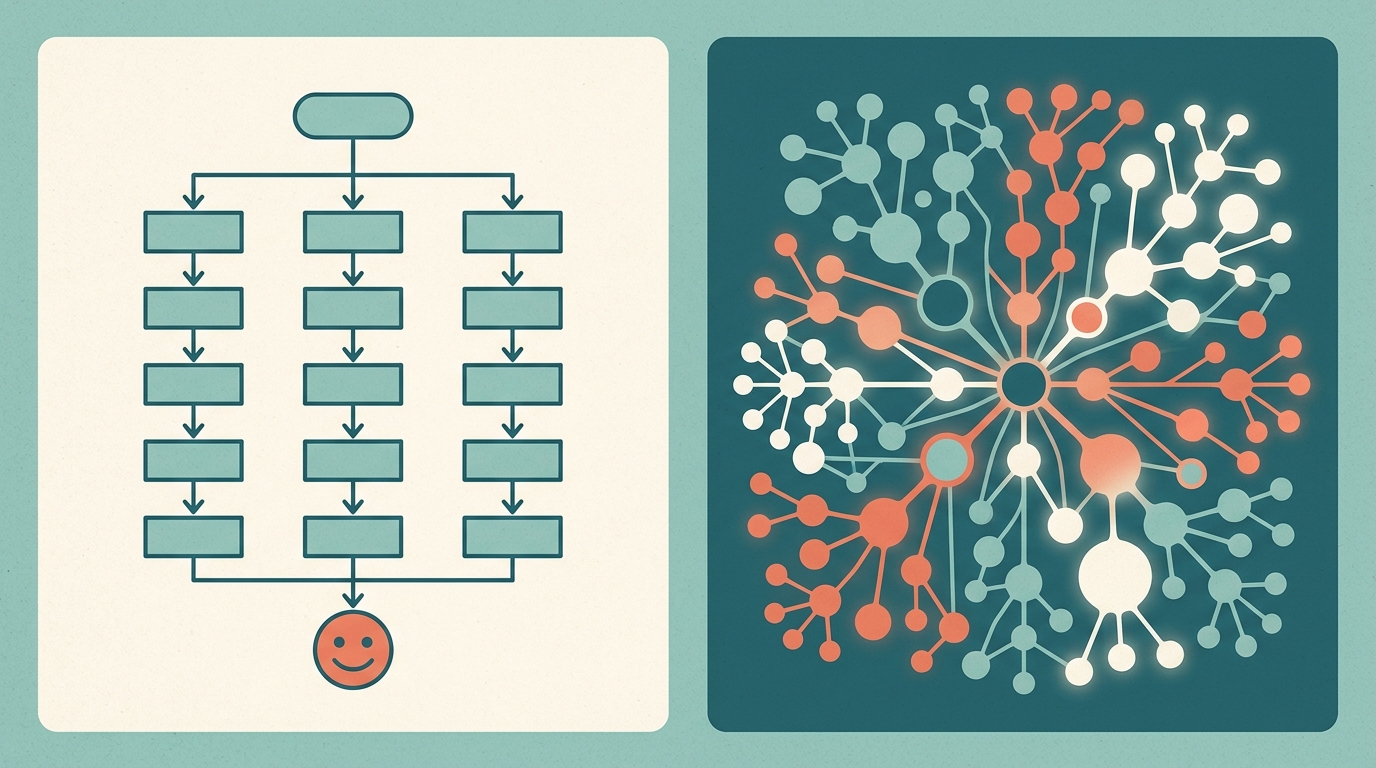
Here's the thing: that frustration is deserved. But it's aimed at the wrong target. The problem isn't chatbots. The problem is template chatbots - the ones that ship with 10 canned responses and a prayer.
The Real Chatbot vs Human Support Question Nobody Asks
When a small business owner Googles "chatbot vs human support," the results are mostly comparison tables from companies selling chatbot subscriptions. Tidio, Intercom, Drift - they all frame it the same way: the bot handles the easy stuff, the human handles the hard stuff. Sounds reasonable.
In practice, it breaks down fast. A plumber's customer doesn't ask "What are your business hours?" - they ask "My water heater is leaking from the top and I have a Rheem 50-gallon tank, can someone come today?" A template bot has no idea what to do with that. It either punts to the human or gives a generic response that makes the business look like it doesn't care.
The question most people should be asking isn't whether to use a chatbot or a human. It's whether to use a generic chatbot or a custom-trained one that actually knows the business.
What a Custom AI Chatbot Actually Does Differently
A custom AI chatbot is trained on your specific data - your services, your pricing, your FAQ, your service area, your scheduling rules. It's not picking from a dropdown of pre-written answers. It's generating responses based on what your business actually does.
The difference matters. When that auto repair shop customer asks "Do you work on 2018 Subaru Outbacks and can I get a brake inspection this week?" a custom bot trained on the shop's data can say: "Yes, we service all Subaru models. Brake inspections are $89 and we usually have same-week availability. Want me to check open slots?" A template bot says: "Thanks for reaching out! A team member will be with you shortly."
One of those responses books the appointment. The other one loses the customer to whoever answers their next Google result.
How This Looks Day-to-Day: A Pet Grooming Salon
Tidio is a solid product. It starts free for up to 50 conversations a month, and the paid plans run $29-$59/month for more features. The problem is that Maria's customers ask things like:
- "How much for a full groom on a 60-pound golden doodle?"
- "Do you do nail grinding or just clipping?"
- "My dog has skin allergies - do you use hypoallergenic shampoo?"
Tidio's template builder can handle the first one if Maria programs specific price tiers. The other two? Dead ends unless she writes flows for every possible variation. She told me she spent an entire Sunday building chatbot flows and still couldn't cover half the questions people actually ask.
Now compare that to a custom AI chatbot trained on Maria's full service menu, her pricing sheet, her product list (yes, including which shampoos she stocks), and her booking rules. The chatbot vs human support gap shrinks dramatically - not because the bot replaces Maria, but because it handles the 70% of questions that are specific but predictable. Maria's phone rings less. The customers who do call are the ones with genuinely complex needs, which is exactly where her expertise matters.
I've built a few of these for Bay Area service businesses through Autom84You - the setup starts at $1,000, which sounds steep next to a $29/month Tidio plan until you realize the custom bot actually answers the questions. One client told me their booking rate from website visitors went up about 40% in the first two months. That's not a guarantee for everyone, but the pattern is consistent: when the bot gives real answers, more people convert.
Honest Pros and Cons
Custom-trained AI chatbot
Pros:
- Answers business-specific questions accurately, including pricing, availability, and service details
- Improves over time as you feed it updated data - new services, seasonal pricing, changed hours
- Available 24/7 without sounding robotic, because it generates natural responses instead of reading scripts
Cons:
- Higher upfront cost ($1,000-$3,000 depending on complexity) compared to template platforms
- Requires someone to update the training data when the business changes - not fully set-and-forget
- Still can't handle genuinely emotional or complex complaints the way a good human can
Template chatbot (Tidio, Intercom, Drift)
Pros:
- Cheap to start - free tiers or $29/month gets you running in an afternoon
- No technical knowledge needed for basic setup
- Good enough for businesses where questions are extremely predictable (hours, location, basic pricing)
Cons:
- Falls apart when questions go even slightly off-script
- Creates a worse impression than having no chatbot at all - customers feel ignored by a robot
- The "connect you to a human" fallback defeats the entire purpose if it fires on most questions
Chatbot vs Human Support: Where Each One Wins
Here's what I've seen after building websites and automation for small businesses over the past several years: the chatbot vs human support debate is a false binary for most shops. The right answer is usually both - but only if the chatbot half is competent.
Humans win at: complaints, negotiations, emotionally charged situations, anything where the customer needs to feel heard. A Nature study published this year found that trust in AI chatbots increases significantly when they exhibit human-like conversational cues and demonstrate reliability - but that trust collapses when the bot clearly doesn't understand the question.
Chatbots win at: after-hours inquiries, repetitive questions that eat up staff time, initial qualification ("what service do you need and when?"), and serving customers who prefer texting over calling - which, in 2026, is most people under 45.
The template platforms - Tidio at $29/mo, Intercom starting around $74/mo, Drift's free tier - are fine if your business gets the same five questions over and over. A pizza shop that only needs to handle "What are your hours?" and "Do you deliver to [zip code]?" doesn't need a custom build. Save the money.
But if your customers ask varied, specific questions - and most service businesses deal with exactly that - the template approach creates more problems than it solves. You're paying for something that makes your business look less responsive, not more.
What to Do This Week
Pull up your current chatbot logs, or if you don't have a chatbot, check your email and voicemail for the last 30 days. Write down the 20 most common questions. If 80% of them are simple and repetitive (hours, location, basic pricing), a template bot is probably fine - Tidio's free plan is a reasonable starting point.
If those questions are varied and specific to your services, a template bot will frustrate more people than it helps. That's where a custom build earns its cost back.
You can see examples of what I've built - including AI chatbots, custom sites, and automation - at autom84you.com/pages/portfolio.php. If you want a straight answer on whether a custom chatbot makes sense for your specific business, email me at nerd@a84y.com. I'll tell you if the $29 option is the right call - sometimes it genuinely is.



Comments
No comments yet. Be the first to share your thoughts!
Leave a Comment