
A guitarist in San Jose told me last month that Bandcamp took $3,200 from her merch sales in 2025. Not in fees she agreed to - she knew the terms. But when she did the math at tax time, fifteen percent of her vinyl and t-shirt revenue going to a platform felt steep for what amounted to a product page and a checkout button. She asked me if there was a way to keep a musician website simple and still sell direct to fans without handing over a cut of every transaction.
There is. It's called Big Cartel, and it's been around since 2005 - quietly powering online shops for independent artists, bands, and makers who want to sell without the overhead.
Why Bandcamp Is the Default (And Why That's Fine)
Bandcamp is popular for good reasons. It has a built-in audience of music buyers. It handles digital delivery, streaming previews, and download codes. For a musician who just wants to upload an album and start selling in twenty minutes, it works. The 15% cut on digital sales and 10% on physical merch is the price of that convenience, and for many artists - especially those starting out - it's worth it.
But once you're past the early stage, once you have your own following on Instagram or an email list of 500 fans, that math changes. You don't need Bandcamp's discovery anymore. You need a musician website simple enough to manage yourself, with a checkout that deposits money into your account minus only the payment processing fee.
Big Cartel: The Musician Website Simple Enough to Run Between Sets
Big Cartel is an e-commerce platform built specifically for independent artists. Not dropshippers, not enterprise retailers - artists. Musicians, painters, printmakers, jewelers. The interface reflects that: it's stripped down to what you actually need and nothing else.
Here's what it costs in 2026:
- Gold plan (free forever): 5 products, custom themes, real-time stats, a free subdomain (yourband.bigcartel.com) or your own domain
- Platinum ($15/month): 50 products, inventory tracking, Google Analytics, discount codes
- Diamond ($26/month): 500 products, everything in Platinum plus advanced inventory management
Zero revenue cuts. Zero listing fees. Your only transaction cost is Stripe's standard 2.9% + $0.30 per sale - the same rate you'd pay processing cards anywhere.
A musician selling $3,200 in merch through Bandcamp pays roughly $320-$480 in platform fees on top of payment processing. The same volume through Big Cartel on the free plan costs $0 in platform fees. On the Platinum plan, $180 for the year. The difference pays for a new pedalboard.
What It Actually Does Day-to-Day
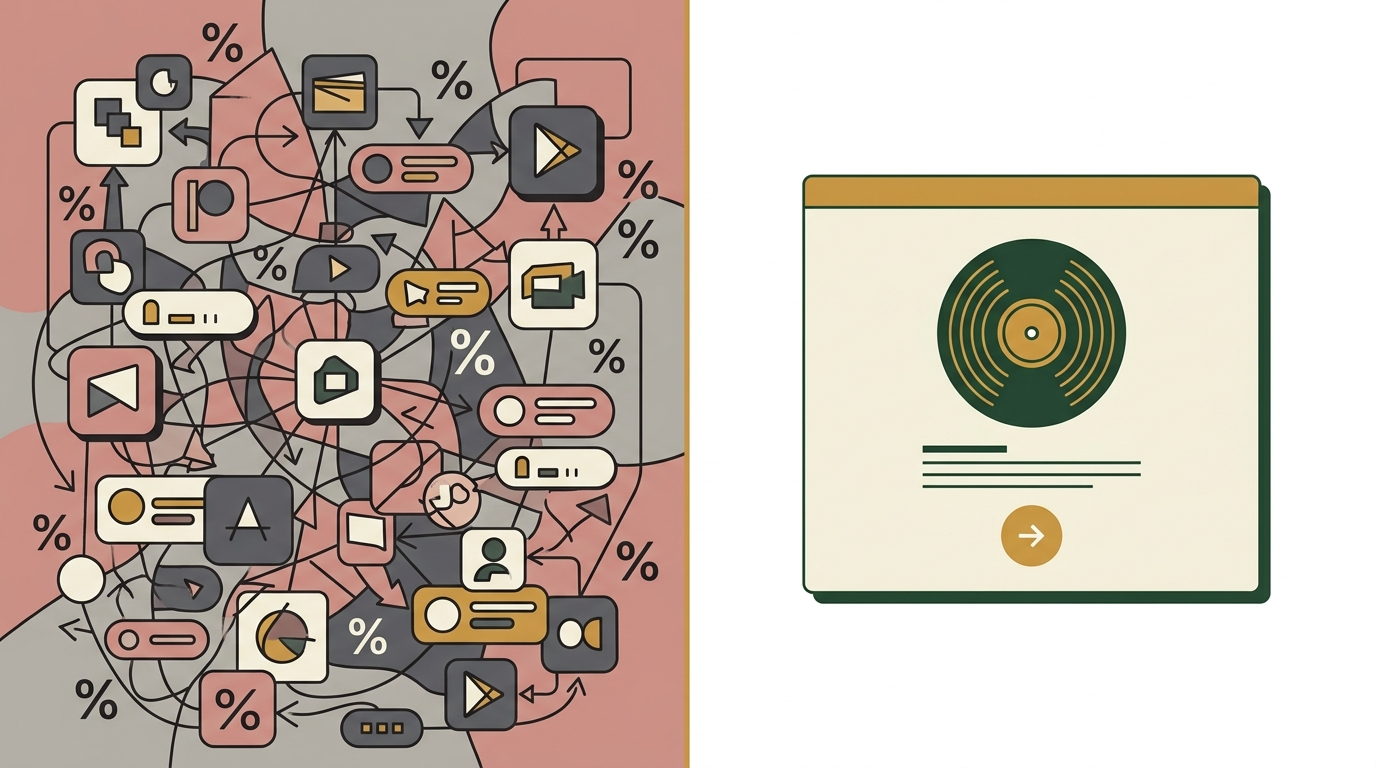
Your daily workflow looks like this:
Morning: Open the Big Cartel app on your phone. Check overnight orders - two t-shirts and a vinyl shipped notification. Mark them as shipped with tracking numbers from Pirate Ship (another quiet tool that gets you commercial USPS rates).
Before a gig: Create a discount code - OAKLANDSHOW20 - for fans who come to tonight's set. Takes thirty seconds in the app.
After a gig: Post an Instagram story with a swipe-up link to your shop. Fans land on a clean product page, not a marketplace cluttered with other artists' work. Your brand, your colors, your layout.
The whole thing feels like managing a simple website, because that's what it is. No dashboards with forty tabs. No analytics suites you'll never read. It keeps a musician website simple by refusing to add complexity you didn't ask for.
Honest Pros and Cons
Three things Big Cartel does well:
- No revenue sharing. Flat monthly fee (or free). You keep what you earn minus standard card processing.
- Purpose-built simplicity. The admin panel assumes you have five minutes between soundcheck and doors. It acts accordingly.
- Custom domain support on every plan, including free. Point yourband.com to your Big Cartel shop and nobody knows it's Big Cartel. It just looks like your site.
Three things to know before committing:
- No built-in music player or digital delivery. Big Cartel sells physical and digital products, but it doesn't stream previews like Bandcamp. You'll need to link to Spotify, SoundCloud, or embed a player separately.
- Limited to 500 products max. If you're running a label with a deep catalog, you'll hit the ceiling. For a solo artist or small band, this rarely matters.
- No built-in audience. Bandcamp has browsers who discover new music on the platform. Big Cartel is your shop, your traffic. You need to bring your own fans - which, if you're reading this, you probably already have.
How It Compares to the Other Options
Big Cartel vs. Shopify: Shopify starts at $39/month (Basic plan) and is built for serious e-commerce operations - inventory across multiple warehouses, wholesale channels, point-of-sale hardware. If you're selling four t-shirt designs and a vinyl record, Shopify is a commercial kitchen when you need a hot plate. Big Cartel is the hot plate, and it works perfectly for what you're cooking.
Big Cartel vs. Squarespace: Squarespace's commerce plan runs $33/month and gives you a beautiful website with a store bolted on. If you need a full band website with a blog, tour dates, press kit, and a store, Squarespace is a legitimate choice. But if you already have a website and just need a place to sell merch, it's paying for a house when you need a garage.
The musician website simple enough to just work - no design degree, no developer, no monthly fees eating into your vinyl margins - that's Big Cartel's lane.
When You Might Want Something More Custom
Big Cartel handles the eighty-percent case well. But some musicians outgrow it. Maybe you want your store, tour dates, EPK, and mailing list all living on one domain with a unified design. Maybe you want to sell lesson packages or fan subscriptions alongside physical merch. Maybe you want a site that loads in under a second on mobile because your fans are scrolling on cellular at festivals.
That's where a custom build starts making sense. I've built a few of these for Bay Area musicians - a clean single-page site with Stripe checkout baked in, no monthly platform fees, just hosting costs under $10/year. You can see some examples at autom84you.com/pages/portfolio.php. For a solo artist who knows what they want, a custom musician website simple in design but specific to their brand usually runs around $500-$750 and takes a week.
But honestly? Start with Big Cartel's free plan. If you outgrow it, you'll know - and you'll know exactly what the custom version needs to do differently because you'll have lived with the limitations.
Your Next Step Is Fifteen Minutes Long
Go to bigcartel.com. Sign up for the free Gold plan. Add your best-selling product - one t-shirt, one record, one sticker pack. Connect Stripe. Point your domain if you have one. The whole process takes about fifteen minutes, and you'll have a working shop before your coffee gets cold.
If you want to keep it even simpler - a single-page site with your music, merch, and show dates all in one place, no platform fees at all - that's the kind of thing I build at autom84you.com. Drop me a line at nerd@a84y.com and I'll tell you straight whether Big Cartel is enough for your setup or whether a custom build is worth the investment. No pitch, just an honest take from someone who's looked at both sides of this more times than is probably healthy.

Comments
No comments yet. Be the first to share your thoughts!
Leave a Comment