
The Math Word Problem Nobody Asked For
If a candle maker sells a lavender soy candle for $24 on Etsy, and Etsy takes a 6.5% transaction fee plus a $0.20 listing fee plus a 3% + $0.25 payment processing fee, how much does the candle maker actually keep?
If you just felt your eye twitch, congratulations - you've been running a small business online.
The dirty arithmetic of selling through major platforms is that fees stack like those Russian nesting dolls, except instead of getting smaller and cuter, each one just takes more of your money. Which is exactly why more shop owners are looking for a small business ecommerce alternative that doesn't treat their revenue like a buffet.
Enter Printify. It's not new, it's not flashy, and it doesn't have a Super Bowl commercial. What it does have is a model that makes actual mathematical sense for small sellers.
What Printify Actually Is (No Jargon, Promise)
Printify is a print-on-demand service. Here's what that means in plain English: you design a product (t-shirt, mug, tote bag, phone case, poster - over 900 options), upload your design, set your price, and list it for sale. When someone buys it, Printify's print partners make it and ship it directly to your customer.
You never touch inventory. You never pre-buy 500 shirts hoping they sell. You never rent a storage unit that slowly fills with unsold merchandise and regret.
The company was founded in 2015, is based in Latvia (yes, Latvia - they're doing fine), and as of 2026 has a network of over 100 print providers across the US, Europe, Asia, and Australia.
Pricing:
- Free plan - full access, you pay base product cost per order
- Premium - $29.99/month, gives you up to 20% off on every product's base cost
- Enterprise - custom pricing for high-volume sellers
The key number: Printify doesn't take a percentage of your sale. You pay the base cost of the product, and the difference between that and your retail price is yours. All of it. No transaction fee. No "platform tax." No surprise line item that shows up like an uninvited cousin at Thanksgiving.
Why Printify Works as a Small Business Ecommerce Alternative
On Printify, a Bella+Canvas 3001 unisex tee costs roughly $9.43 at base (Premium plan). You sell it for $28 on your own website. Your profit: $18.57 per shirt, minus whatever your payment processor charges (usually around 2.9% + $0.30 through Stripe or Square - so about $1.11). Net profit: roughly $17.46.
Now sell that same shirt through a marketplace like Etsy or Amazon Merch. Layer on listing fees, transaction fees, payment processing fees, and the occasional advertising fee they nudge you toward. You're looking at keeping maybe $12-14 on a good day. On Amazon, potentially less.
That $3-5 difference per shirt adds up. Sell 100 shirts a month and you're leaving $300-500 on the table - enough to cover your Premium subscription seventeen times over.
This is why Printify keeps showing up in conversations about finding a small business ecommerce alternative. The math just... works.
A Real Example: How a Dog Groomer Would Use This
Meet hypothetical Jenna. She runs a dog grooming salon in San Jose called Bark & Shine. Her clients are obsessed with their dogs (obviously - it's the Bay Area, the dogs have better skincare routines than most humans).
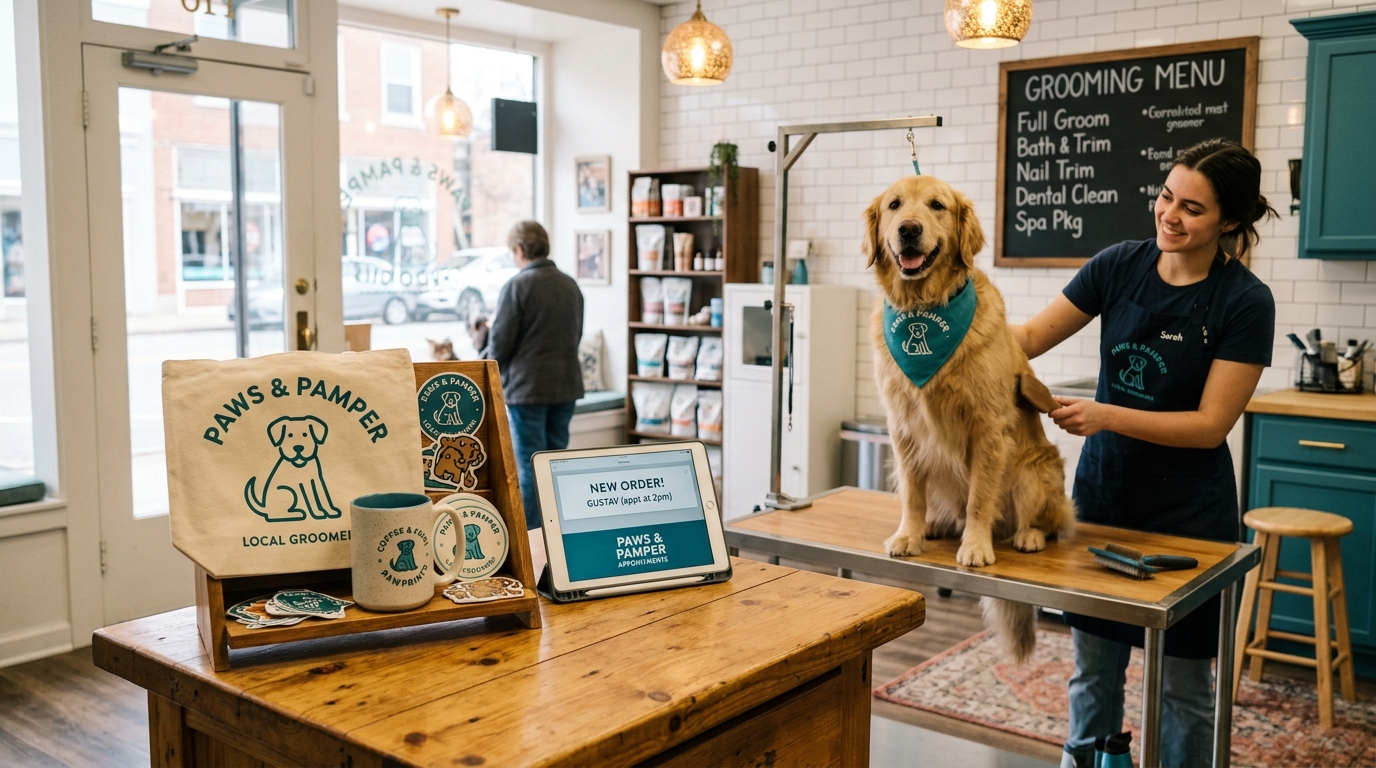
Jenna designs a few simple products: a "Bark & Shine" branded tote bag for carrying grooming supplies, a bandana with her logo that dogs wear home after their appointment, and a coffee mug that says "I smell like wet dog and I'm fine with it."
She connects Printify to her existing website through their WooCommerce integration (they also integrate with Shopify, Etsy, Wix, Squarespace, and BigCommerce). When a client orders a mug from her site, Printify prints it and ships it. Jenna gets a notification, the customer gets a tracking number, and Jenna never had to figure out where to store 200 mugs.
She sells the tote for $22 (base cost: ~$8.50). The bandana for $15 (base cost: ~$6). The mug for $18 (base cost: ~$7). She's making $7-14 per item with zero inventory risk and zero shipping headaches.
Now here's where it gets interesting for her actual business: those branded items become walking advertisements. Every dog wearing a Bark & Shine bandana at the dog park is a tiny billboard. Every tote bag at the farmers market is a conversation starter. The merch isn't just revenue - it's marketing that pays for itself.
If Jenna wanted to take it further, she could set up a QR code on the bandana tag that links to her booking page. Now the dog park billboard has a call-to-action. That's the kind of small-business-ecommerce-alternative thinking that turns a side hustle into a real channel.
The Honest Pros and Cons
Three things Printify does well:
- No upfront inventory cost. You're not gambling on demand. If nobody buys your "World's Okayest Plumber" shirt, you're out $0. Compare that to ordering 200 shirts from a screen printer and hoping for the best.
- Huge product catalog. Over 900 products across multiple print providers. T-shirts, hoodies, all-over prints, canvas prints, stickers, jewelry, pet products, home decor. If you can put a design on it, they probably have it.
- Multiple print provider options. For most products, you can choose from several fulfillment partners and compare pricing, production time, and shipping costs. Competition between providers keeps quality up and prices reasonable.
Three things to watch out for:
- Quality varies by provider. Since Printify is a marketplace connecting you to print partners, not every provider delivers the same quality. Read reviews, order samples (they offer discounts on samples), and test before you list. This is non-negotiable.
- Shipping times can be unpredictable. Production typically takes 2-5 business days, then shipping on top. During holidays, plan for delays. If your customers expect Amazon Prime speeds, set expectations clearly on your product pages.
- You need your own traffic. Printify isn't a marketplace - nobody browses Printify looking for products to buy. You need your own website, social following, or existing customer base to drive sales. It's a production partner, not a storefront with foot traffic.
How It Compares to Printful and Spring
Printful is the other big name in print-on-demand. Higher base product costs (typically 15-25% more than Printify), but they handle their own fulfillment in-house rather than using third-party providers. That means more consistent quality and better branding options (custom packing slips, branded inserts). If brand experience matters more than margin, Printful is worth considering. But for a small business ecommerce alternative where every dollar counts, Printify's lower base costs usually win.
Spring (formerly Teespring) is more creator-focused - YouTubers, streamers, influencers. It gives you a free storefront, which is nice if you don't have a website. But the customization is limited and it feels more like merch-for-fans than products-for-customers. If you're a business, not a content creator, Printify fits better.
There are also broader platform alternatives worth evaluating if you're comparing payment processing and point-of-sale alongside your online store - Square competitors like Toast, Clover, and PayPal Zettle each have their own ecommerce features worth a look.
The Part Where I Mention That I Build These Setups
Full transparency: at Autom84You, I've helped a handful of Bay Area small businesses connect print-on-demand to their existing websites. The setup itself isn't complicated - most integrations take an afternoon. The part that takes thought is designing the product pages so they actually convert, setting up the right payment flow, and making sure the shipping expectations are clear so you don't get angry emails.
If you already have a website and want to add a merch or product line without the inventory headache, that's a straightforward custom build. If you don't have a website yet, that's an even better reason to start with one that has ecommerce baked in from day one instead of bolting it on later like a spoiler on a Honda Civic.
Your Homework (It's Easy, I Promise)
Here's what you can do in the next 30 minutes if this sounds interesting:
- Go to Printify.com and create a free account.
- Pick one product - just one. A mug or a tote bag. Something simple.
- Upload your logo or a design. If you don't have one, use Canva's free tools to make something basic.
- Order a sample. It'll cost you under $15 shipped.
- Hold it in your hands and decide if the quality is good enough for your customers.
That's it. No commitment, no subscription, no "free trial that auto-charges you $49.99 because you forgot to cancel." Just a sample you can evaluate like a reasonable human being.
A good small business ecommerce alternative shouldn't require a leap of faith. It should require a $12 mug and an honest assessment of whether you'd put your name on it.
And if you get to step five and think "okay, I want to build this into my actual website" - that's literally what I do. Drop me a line at nerd@a84y.com or check out autom84you.com. I'll help you get the store page up without the word problem.


Comments
No comments yet. Be the first to share your thoughts!
Leave a Comment