
A software engineer's brutally honest assessment of AI productivity at work went viral last week. Business Insider, Futurism, and a dozen other outlets picked it up. The gist: most of the AI tooling being pushed on developers doesn't actually make them faster - it just makes management feel like something is happening. Meanwhile, O'Reilly published a piece called Don't Automate Your Moat, arguing that companies are handing their competitive advantages to AI systems that flatten everyone to the same output. Two different stories, same conclusion. The developer productivity honest conversation is finally happening in public, and it's about time.
Developer Productivity Honest: The Viral Post That Said What Everyone Thought
The Business Insider story covered a developer who posted a detailed breakdown of how AI tools affected their actual output over several months. Not vibes. Not 'I feel 10x faster.' Tracked hours, tracked commits, tracked bugs introduced. The conclusion: AI coding assistants helped with boilerplate and documentation but actively slowed down complex architectural decisions because the developer spent more time reviewing and correcting AI output than they would have spent writing it themselves.
People lost their minds. Not because it was controversial - because it matched what most working developers already experienced but hadn't said publicly. The comment sections were full of engineers saying some version of 'finally, someone said it.'
Why it matters if you run a small business: If you're a solo operator - a wedding photographer managing your own site, an HVAC contractor handling your own scheduling system, a dog groomer who built a booking page - you've probably seen the same AI productivity promises aimed at you. 'This tool will save you 10 hours a week.' Maybe. Or maybe you'll spend 6 of those 10 hours figuring out why the tool did something weird. The developer productivity honest take applies to every small business owner using tech tools, not just engineers.
The O'Reilly Warning: Stop Automating the Thing That Makes You Different
O'Reilly Media's piece made a different but connected argument. When everyone uses the same AI tools to produce the same outputs, nobody stands out. If every real estate agent in San Jose uses the same AI to write listings, every listing sounds identical. If every restaurant in the South Bay uses the same chatbot template, every customer interaction feels the same.
The article called this 'automating your moat' - taking the one thing that differentiates your business and handing it to a system designed to produce average output at scale.
What to do about it: Automate the stuff that doesn't define you. Invoicing, appointment reminders, data entry, report formatting - that's where AI saves real time without costing you anything unique. But if your competitive edge is how you communicate with clients, or how your website tells your story, or how your proposals read - be careful what you hand off. I've built custom sites and AI tools for small businesses across the Bay Area, and the best results always come from automating the boring backend while keeping the human-facing layer sharp and specific to that business.
The $400/Month Productivity Stack Nobody Needs
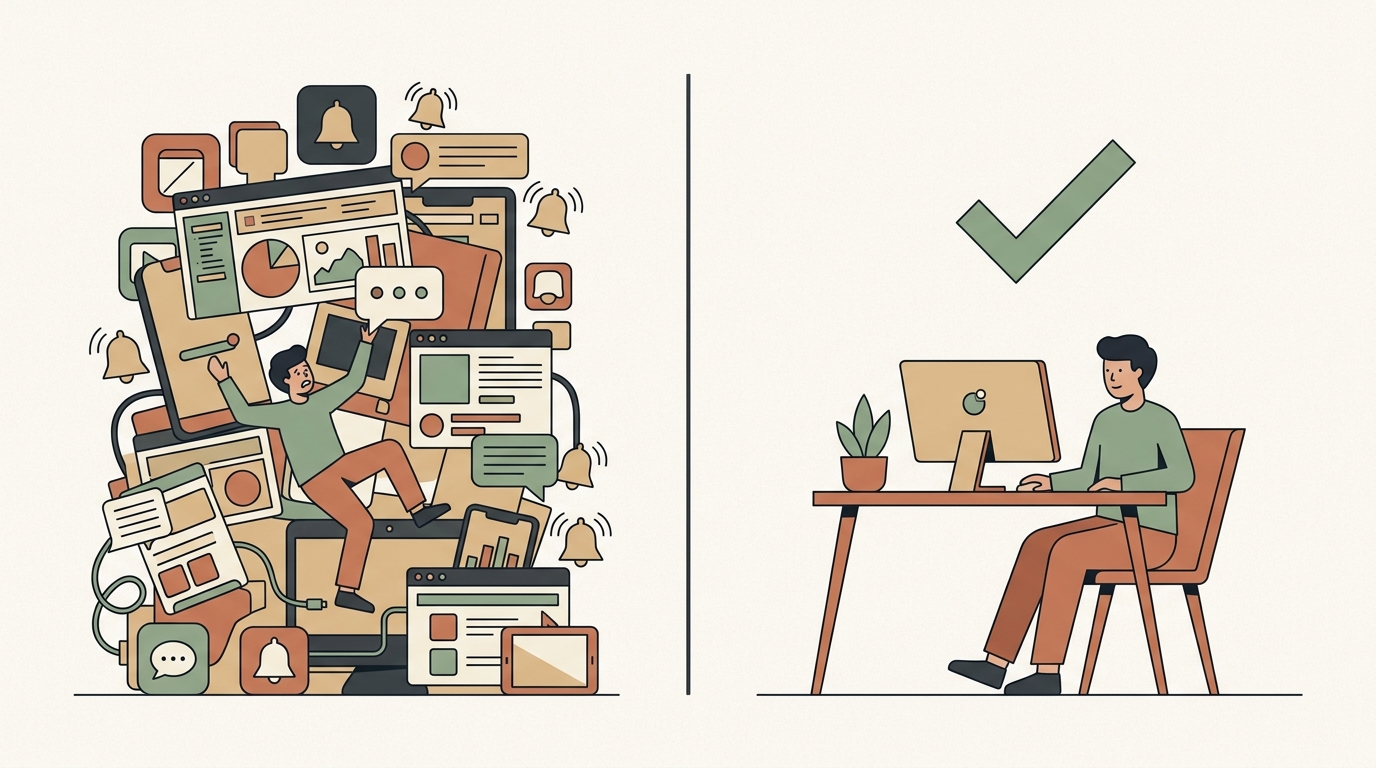
The developer productivity honest reality for solo operators is this: you don't need a system to tell you whether you shipped. You either shipped or you didn't. A freelance bookkeeper doesn't need a Kanban board. A mobile car detailer doesn't need sprint planning. The popular advice is built for teams of 10-50 people trying to coordinate. It actively hurts teams of one.
The quieter alternative: A plain text file, a calendar with time blocks, and one communication tool. That's it. I run Autom84You solo - custom websites, AI chatbots, automation builds - and my entire productivity system is a markdown file, Google Calendar, and email. Total cost: $0. Total time managing the system: about 4 minutes a day.
Does that sound too simple? Good. Simple is what actually scales to one person. Every minute you spend configuring your productivity tool is a minute you're not billing a client or building something that brings in the next client.
What the Bigger Picture Looks Like
These three threads - the viral AI honesty, the 'don't automate your moat' warning, and the productivity tool bloat problem - all point at the same thing. The popular advice about developer productivity is designed for a world that most solo operators don't live in. It assumes you have a team to coordinate with, a manager to report to, and a budget that absorbs $400/month in SaaS subscriptions without blinking.
When you work alone, the developer productivity honest answer is different. You need fewer tools, not more. You need AI where it actually saves time (repetitive tasks, first drafts of boilerplate, data processing), not where it replaces your judgment. And you need to protect the things that make your clients choose you over the next person - your voice, your taste, your way of solving problems.
The mainstream path is to stack tools and hope the dashboard turns green. The alternative path is to strip everything back to what directly produces output and delete the rest.
The Two Things Worth Paying Attention To
First: AI tools are getting better fast, but 'better' doesn't mean 'appropriate for every task.' The developer productivity honest conversation will keep evolving. Check back in six months and the specific tools will be different, but the principle holds - measure what you actually ship, not what your tool says you did.
Second: The businesses that will look most distinctive in 2027 are the ones that automated their back office ruthlessly while keeping their customer-facing work human and specific. A taco truck with a custom online ordering system that sounds like them, not like a template. A yoga studio with a booking flow that reflects their actual vibe, not a generic widget. If you want to see what that kind of specific-to-you build looks like in practice, the portfolio has recent examples.
Most productivity advice online is written by people selling productivity tools. That's not a conspiracy - it's just incentives. When someone whose income depends on you subscribing to their platform tells you that you need their platform, factor that in.
If you want a second opinion on your current tool stack - whether you're over-tooled, under-tooled, or spending money on something a $0 alternative handles better - send a note to nerd@a84y.com. I'll be honest about it, even if the honest answer is that what you have already works fine.




Comments
No comments yet. Be the first to share your thoughts!
Leave a Comment