
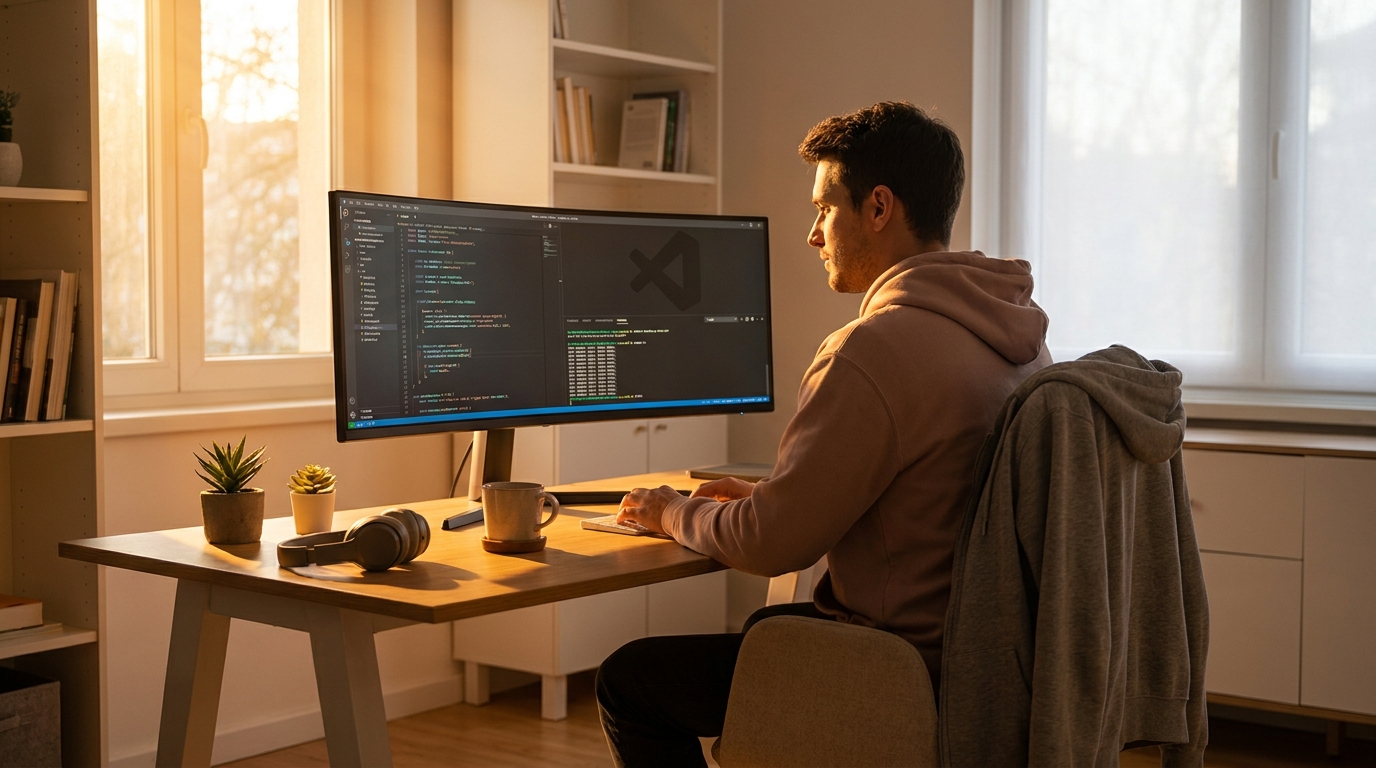
My actual workspace has three monitors, a mechanical keyboard I've spilled coffee on twice, and a browser with 47 tabs I'm emotionally attached to. If you photographed it for a 'top freelance dev tools' listicle, the art director would quit on the spot.
But here's the thing: that messy setup ships code. It invoices clients. It keeps a one-person operation running without a single project manager, Scrum board, or stand-up meeting where someone shares their screen for eleven minutes to show you a button.
So let's talk about what's actually happening in the world of freelance dev tools right now - not the airbrushed version, but the real one. Three trends worth paying attention to, especially if you're running a small business or working with someone who does.
Solo Devs Are Building Their Own Freelance Dev Tools With AI
Business Insider recently profiled five solo business owners who stopped waiting for the perfect SaaS product and started building custom tools with AI instead. Not billion-dollar startups. Regular people running real businesses who got tired of paying $49/month for software that did 80% of what they needed and 200% of what they didn't.
This tracks with what I see every week building tools for small businesses at Autom84You. A dog groomer doesn't need Salesforce. They need a booking page that texts reminders and doesn't look like it was designed by a committee in 2011. A wedding photographer doesn't need a full DAM system - they need a gallery that loads fast and has a download button that actually works.
The shift here is real: AI coding assistants like Claude and Cursor have made it possible for a solo dev to build a custom internal tool in an afternoon instead of a sprint. I built a client's entire appointment-and-invoice flow in a weekend using AI-assisted coding. Two years ago, that's a two-week project with three rounds of revision.
If you're a small business owner, this means custom software isn't just for companies with IT departments anymore. A freelance developer with the right freelance dev tools can build you something tailored to exactly how you work - not how some product manager in San Francisco thinks you should work.
The Real Freelance Dev Tools Stack Looks Like a Yard Sale
Every few months, someone publishes a '19 Best Tools for Developers' article - Designmodo just dropped one - and every few months, I read it, nod politely, and go back to my actual setup, which includes at least two tools the author would judge me for.
Here's what the listicles won't tell you: the best freelance dev tools are the ones you've already bent to your workflow. My project management system is a combination of a plain text file, a calendar app, and the anxiety in my chest. It works. I've tried Notion, Asana, Monday, ClickUp, and a whiteboard. The text file won.
The trend right now - and Modern Diplomacy covered this recently - is that productivity tools are fragmenting. Instead of one app that does everything poorly, solo devs are stitching together small, specific tools that each do one thing well. A $5/month DNS manager here. A free uptime monitor there. A marketing dashboard like the one I built at links.autom84you.com that tracks QR codes and campaign links without requiring a PhD in Google Analytics.
This frankenstein approach horrifies enterprise consultants. It delights freelancers. Because when something breaks - and something always breaks - you swap out one small piece instead of migrating your entire business off a platform that just got acquired and tripled its pricing.
Your Freelance Dev Tools Need a Bouncer at the Door

Wired reported this month that a group of North Korean hackers - not elite ones, mediocre ones - used AI tools to build malware, fake company websites, and phishing campaigns that hit over 2,000 developers. They stole $12 million in cryptocurrency in three months. Their coding skills were described as essentially nonexistent. AI did the heavy lifting.
Why does this matter to a freelancer or a small business owner? Because the same AI that makes freelance dev tools more powerful also makes the people trying to break into your systems more capable. That phishing email that used to have obvious typos and weird formatting? It reads like a real vendor invoice now.
If you're a solo dev, this means taking ten minutes to set up two-factor authentication on every tool you use. It means not clicking links in emails from 'clients' you don't recognize, even if the email looks polished. It means keeping your dependencies updated, which I know is about as fun as flossing, but the alternative is worse.
If you're a small business owner working with a developer, ask them about security. Not in a paranoid way - in a 'hey, are we good?' way. A decent dev will appreciate the question. At Autom84You, security isn't an add-on - it's baked into every project because rebuilding a hacked website costs way more than building it right the first time.
The Bigger Picture: Your Tools Should Fit You
These three trends - custom AI-built tools, fragmented-but-functional stacks, and the rising security bar - all point in the same direction: the era of one-size-fits-all freelance dev tools is ending.
The solo dev who builds a taco truck owner a custom ordering page with AI assistance isn't using the same stack as the agency building enterprise dashboards. And they shouldn't be. The HVAC company that needs a simple quote calculator doesn't need the same tools as a SaaS startup. The right tools are the ones that match the job, the budget, and the person using them.
What's worth paying attention to right now:
First: If you're still paying for software you only use 20% of, it might be cheaper to have someone build exactly what you need. Custom sites start at $500, and AI chatbots trained on your actual business data start at $1,000. That's less than a year of most SaaS subscriptions that send you 'we miss you' emails.
Second: Security hygiene is no longer optional. Two-factor everything. Update everything. Be skeptical of emails that seem too well-written - ironic advice, but here we are in 2026.
My freelance dev tools aren't photogenic. They won't make anyone's curated list. But they ship work for real clients every week, and they haven't been compromised by mediocre hackers, which at this point feels like something to put on a résumé.
If you want someone to look at your setup - your website, your tools, your workflow - and tell you honestly what's working and what's held together with duct tape and optimism, that's literally what I do. Hit me at nerd@a84y.com or check out autom84you.com. I'll bring the coffee. You bring the 47 open tabs.


Comments
No comments yet. Be the first to share your thoughts!
Leave a Comment