
A plumber in San Jose told me last month that he'd signed up for four different AI tools in 2025. Total cost: about $380 a month. Total leads generated: maybe three. He wasn't angry - he was tired. Tired of being sold magic and getting a slightly fancier spreadsheet.
That conversation stuck with me because it's the same story I hear from salon owners, HVAC contractors, and taco truck operators across the Bay Area. Everyone's heard that ai automation for small business is supposed to be the big thing. The pitch is always the same: save time, make more money, work less. The reality? Most of these tools assume you have a marketing team, a developer on retainer, and four hours a day to learn a new dashboard.
So let's cut through it. I've spent the last year building, testing, and wiring up AI tools for local businesses through Autom84You. Some of these tools are genuinely useful. Some are expensive toys. Here's the honest breakdown.
The AI Automation for Small Business Tool That's Actually Delivering
The tool I keep coming back to - and the one I've set up for more clients than any other - is Tidio AI. Specifically, their Lyro AI chatbot.
Here's what it is in plain terms: a chatbot that sits on your website, answers customer questions using your actual business information, and hands off to you (via text or email) when it can't handle something. It learns from your FAQ page, your service descriptions, your pricing - whatever you feed it.
Pricing: Lyro starts at $39/month for 50 AI conversations. The $79/month plan gets you 150. For most local businesses doing under 500 website visits a day, the base plan is more than enough.
Why this one? Because it solves the actual problem most small businesses have: missed leads after hours. Not "brand awareness." Not "content strategy." Missed phone calls at 9 PM from someone whose water heater just broke.
What This Looks Like for a Real Business
Let me give you a specific example. A dog groomer in Campbell - three employees, about 40 appointments a week - installed Lyro on her site in January. She fed it her pricing sheet, her breed-specific grooming notes, and her cancellation policy.
Within the first month, the bot handled 127 conversations. About 60% were simple questions: "How much for a golden retriever?" "Do you do nail grinding?" "What's your Saturday availability?" The bot answered all of those instantly, 24/7. Another 25% were booking requests that got forwarded to her phone as texts. The remaining 15% were edge cases the bot flagged for her to handle manually.
She told me she used to spend about 45 minutes a day answering those exact questions over the phone and through Instagram DMs. Now she doesn't. That's real time back - not a theoretical efficiency gain from a McKinsey slide deck.
Pros and Cons - No Sugarcoating
Three things Lyro gets right:
- Setup is genuinely fast. If you have a decent FAQ page, you can be live in under an hour. I've done it in 20 minutes for clients with clean websites.
- The handoff to a human actually works. When the bot hits its limit, it doesn't just say "sorry" - it collects the customer's info and routes it to you. That's the part most chatbots fumble.
- It speaks like a normal person. The responses don't sound like they were written by a corporate committee. You can adjust the tone, and it stays consistent.
Three things that aren't great:
- The 50-conversation limit on the base plan can run out fast if your site gets decent traffic. And jumping to the next tier doubles your cost.
- It can hallucinate details if your training data is thin or contradictory. I've seen it confidently quote the wrong price because a client had outdated info on a buried page. You have to audit what you feed it.
- Multi-language support exists but it's rough. If you serve a bilingual community - and in the Bay Area, a lot of businesses do - you'll need to test it carefully.
How It Compares to the Alternatives
Intercom Fin is the premium option. It's more powerful, integrates with more tools, and handles complex workflows better. But it starts at $99/month per agent and really shines at scale - meaning it's built for companies with support teams, not a sole proprietor juggling QuickBooks and a leaf blower. Overkill for most local businesses.
ManyChat is the budget option, especially if your business lives on Instagram and Facebook. It's great for automated DM responses and simple flows. But it doesn't do the knowledge-base learning that Lyro does - it's more like a decision tree than an actual AI. Fine for "reply MENU to see our specials," less fine for "do you use organic shampoo on cats with sensitive skin?"
For most small businesses spending under $100/month on ai automation for small business tools, Lyro hits the sweet spot between capability and complexity.
Where AI Automation for Small Business Gets Interesting
Here's the thing most articles about ai automation for small business won't tell you: the real value isn't in any single tool. It's in how you connect them.
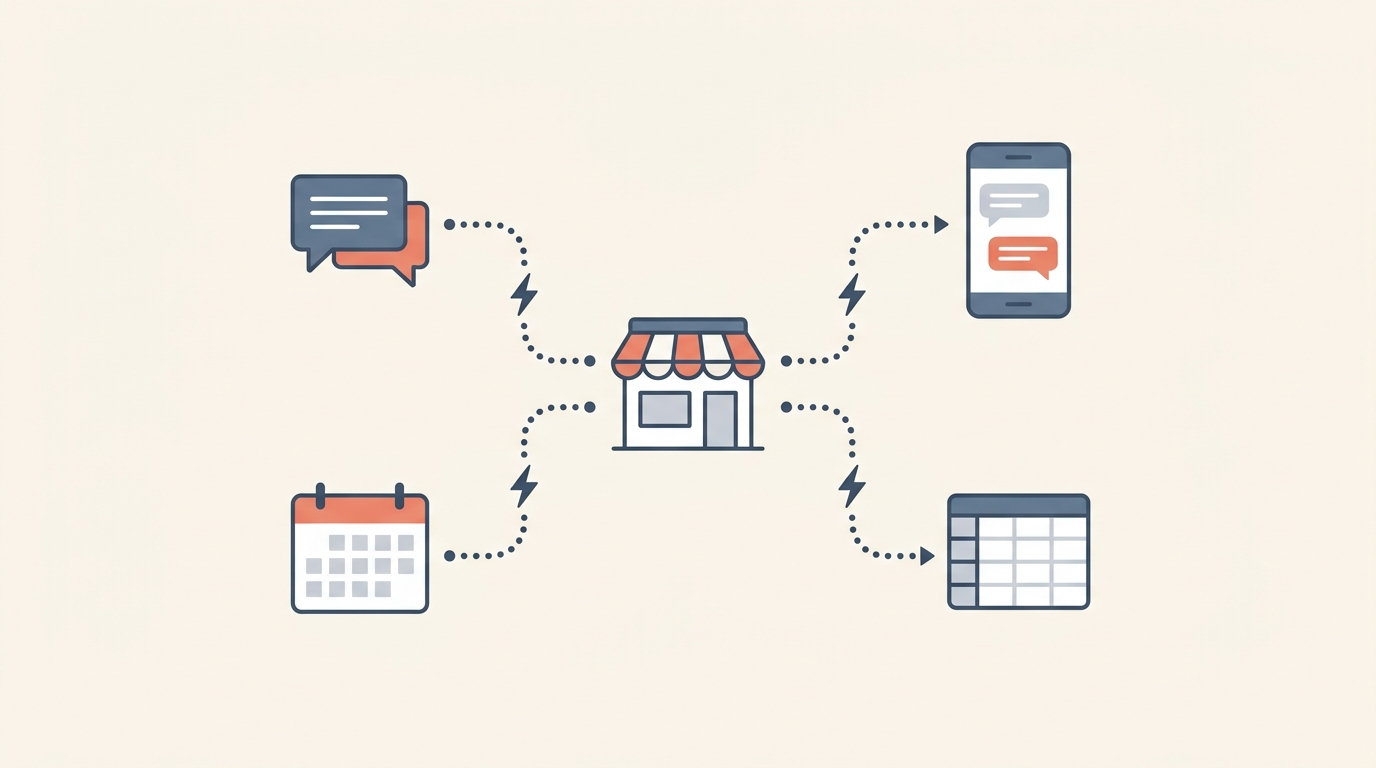
That dog groomer in Campbell? Lyro handles her website chat. But I also wired up a system where new booking requests automatically get added to her Google Calendar, trigger a confirmation text to the customer via Twilio, and log the appointment in a simple Airtable base she uses instead of a paper book. Total cost beyond Lyro: about $30/month for Twilio and Airtable's free tier.
That's ai automation for small business that actually works - not because any single piece is revolutionary, but because someone took the time to connect the pieces for her specific workflow. She didn't need to learn APIs or watch YouTube tutorials. She needed someone to sit down, understand how her Tuesday looks, and build accordingly.
That's what I do at Autom84You. Custom AI chatbots trained on your actual business data start at $1,000 - and that includes the wiring to your calendar, your CRM, your text notifications, whatever you actually use day-to-day. Not a generic bot that says "thanks for reaching out!" and then does nothing.
The Cognitive Surrender Problem
One more thing worth mentioning. Recent research from the University of Pennsylvania - covered by Ars Technica this week - found that people are increasingly engaging in what they call "cognitive surrender" to AI. Basically: trusting the output without checking it.
This matters for small business owners because the tools are only as good as what you feed them and how you monitor them. That dog groomer checks her chatbot's conversation logs every Friday. She's caught two pricing errors and one weird response about "cat aromatherapy" that Lyro invented from nothing. The tool works because she treats it like an employee - useful, but needs supervision.
If you're going to invest in ai automation for small business, invest ten minutes a week reviewing what the AI actually said to your customers. The businesses that get burned are the ones that set it and forget it.
Your Actual Next Step
If you've been thinking about adding a chatbot or automating the repetitive parts of your day, here's what I'd do this weekend:
- Go to your website. Read your FAQ page or services page out loud. If it's confusing to you, it'll be confusing to an AI. Clean it up first.
- Sign up for Lyro's free trial (they give you 50 conversations free, no credit card). Feed it your cleaned-up content. Let it run for two weeks.
- Check the conversation logs. See what people are actually asking. That data alone is worth the experiment - even if you decide the bot isn't for you.
And if you look at those logs and think "I want this to do more but I don't know how to wire it all together" - that's literally the thing I build. I'm a solo developer in Sunnyvale who's spent 20+ years doing exactly this kind of work. No agency overhead, no six-month timelines. Just the actual solution, built for how your business actually runs.
Shoot me a note at nerd@a84y.com or check out autom84you.com. I'll tell you straight whether it's worth your money or not. Sometimes the answer is no - and I'd rather say that upfront than sell you something you don't need.




Comments
No comments yet. Be the first to share your thoughts!
Leave a Comment