
The $400 Mistake That Taught Me Everything About AI Automation for Small Business
A few months ago, I built an AI trading bot. Not for a client - for myself. I wanted to see if I could wire up a system that watched stock prices, spotted patterns, and executed trades without me hovering over a screen at 6:30 AM.
It worked. Sort of. The first version made three trades in a row that netted me $87. Then it misread a volatility spike and lost $400 in eleven minutes.
I shut it down, stared at my terminal, and realized something: the bot wasn't broken. My instructions were. I'd told it what to do but not when to stop. No guardrails. No "hey, if things look weird, pause and wait."
That single lesson - that AI automation for small business lives or dies on how well you define the rules - is worth more than any tool recommendation I could give you. But I'm going to give you tool recommendations anyway, because this isn't a philosophy class. You've got a business to run.
What a Trading Bot Has in Common With Your Plumbing Company
Here's the thing most people miss: every AI automation system does the same three things, whether it's trading stocks or answering phone calls for a plumber in San Jose.
1. It watches for a trigger. For my bot, the trigger was a price crossing a moving average. For a plumbing company, the trigger might be a new form submission on your website, or a missed phone call, or an invoice that's 30 days overdue.
2. It follows a decision tree. My bot checked: is the volume high enough? Is the trend confirmed by a second indicator? For your business, it might be: is this a new customer or returning? Is this a service we offer? Is this during business hours?
3. It takes an action. The bot placed a trade. Your system might send a text back to the customer, create a job in your CRM, or flag a lead as high-priority for you to call back personally.
The structure is identical. The stakes are different - and honestly, for most small businesses, the stakes are lower and the payoff is higher than stock trading. Nobody's losing $400 in eleven minutes because their auto-reply texted a customer too fast.
The Tool That Actually Does This Well: CallVanta
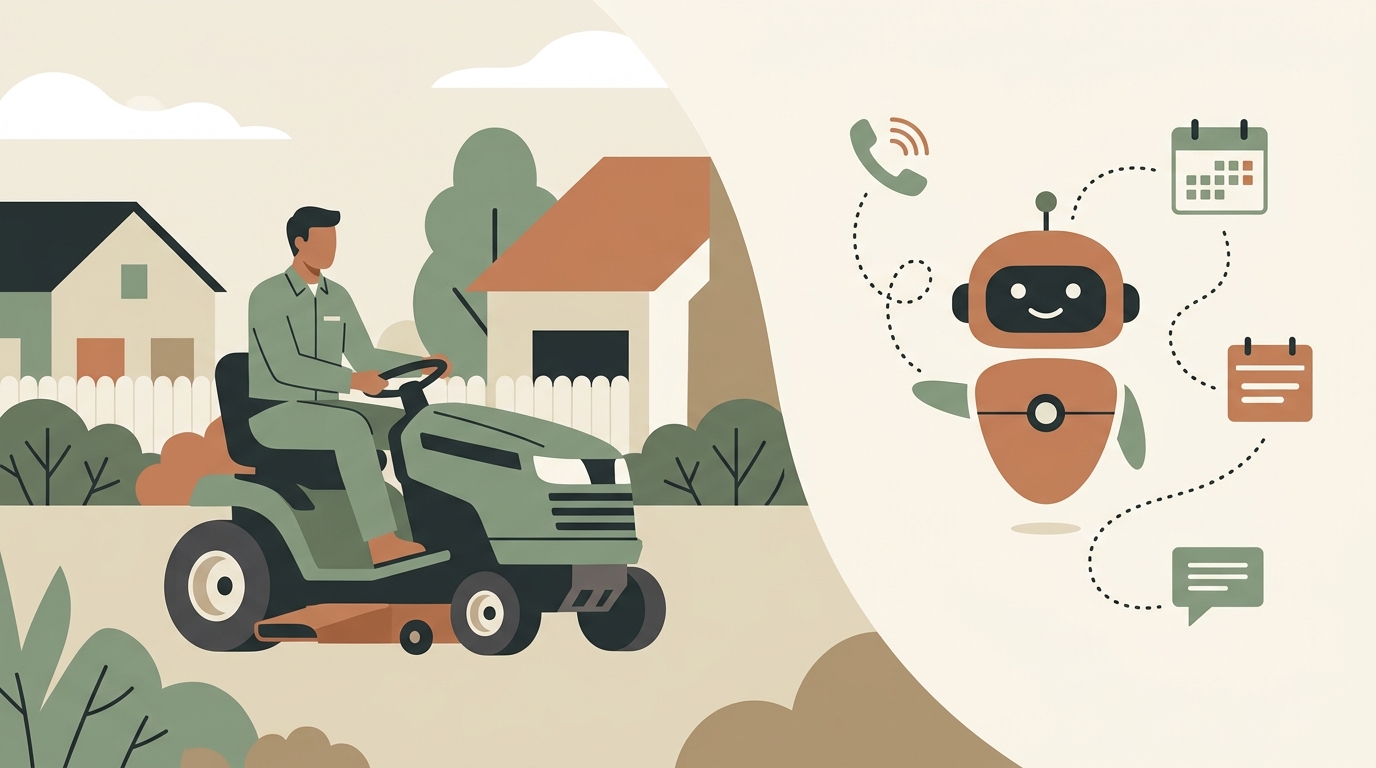
I've been watching a company called CallVanta since they launched earlier this year. Founded by Alan Weeks, who ran service businesses for 25 years before building this, it's an AI phone answering and automation platform built specifically for service-based small businesses.
What it does in plain English: when a customer calls your business and you can't pick up, CallVanta's AI answers, has a natural conversation, figures out what the caller needs, and either books an appointment, sends you a summary, or routes the call - depending on rules you set up.
Pricing starts at $97/month for up to 100 calls. The mid-tier plan at $197/month adds CRM integration and custom call flows. Not cheap for a solo operator, but consider this: the average missed call for a service business represents $200-$1,200 in lost revenue, depending on the trade. Miss five calls a month and the math does itself.
How a Real Landscaping Company Would Use This
Let's say you run a landscaping crew out of Fremont. Four trucks, six employees, and a phone that rings while you're on a mower or driving between jobs.
Monday, 10:15 AM: A homeowner calls about a backyard redesign. You're elbow-deep in a sprinkler repair. CallVanta picks up, asks a few qualifying questions - property size, timeline, budget range - and books a site visit for Wednesday afternoon. You get a text summary with all the details.
Monday, 2:30 PM: Someone calls asking if you do tree removal. You don't. The AI politely says so and offers to text them a referral. No wasted time for either of you.
Tuesday, 8:00 AM: An existing client calls about a billing question. The AI recognizes the number, pulls up the account, and routes the call to your office manager's cell.
None of this is science fiction. This is exactly the kind of ai automation small businesses can set up right now, today, with tools that already exist.
Pros and Cons - Honest Ones
What's good:
- It's built by someone who actually ran service businesses, not a Silicon Valley team guessing what plumbers need
- The AI voice quality is legitimately good - callers usually don't realize it's not a person for the first 30 seconds
- Setup takes about an hour if your call flow is simple (answer, qualify, book or route)
What's not:
- $97/month is a real cost for a solo operator making $4K-$6K/month - you need to actually be missing calls for this to pay off
- Complex call flows (multiple services, different pricing tiers, seasonal availability) require their consulting add-on, which isn't cheap
- It's new. The company launched in 2026. That means less battle-testing, fewer integrations, and the usual risks of betting on a young product
Two Alternatives Worth Knowing About
Smith.ai - Been around longer, starts at $292.50/month for 30 calls. More expensive per call, but they blend AI with human receptionists, so complex calls get handed to a real person. If your callers tend to have complicated needs (law firms, medical offices), this hybrid approach might be worth the premium.
A custom AI chatbot on your website - This won't answer your phone, but it handles the same problem through a different channel. I've built these for clients starting at $1,000 - trained on their actual service menu, pricing, and FAQs. For businesses where most leads come through the website rather than phone calls, this is often the smarter investment. You can see a few examples on my portfolio page.
What My Trading Bot Disaster Actually Taught Me
The reason I'm telling you about my trading bot failure isn't to be self-deprecating. It's because the lesson applies to every piece of AI automation you'll ever set up:
Define the boundaries before you define the actions.
Before you tell an AI system what to do when a customer calls, decide what it should never do. Should it never quote a price? Never promise a specific date without checking with you? Never handle calls from existing clients differently than new ones?
My bot lost money because I told it when to buy but was vague about when to stop. Your AI phone system will frustrate customers if you tell it how to answer but not when to say "let me have the owner call you back personally."
The businesses I've helped set up automation for - through Autom84You - the ones that get the best results are the ones who spend 80% of the setup time on the rules and edge cases, and 20% on the actual tools. The tool is the easy part. Knowing your business well enough to write clear instructions for a machine? That's the real work.
What I'd Do This Week If I Were You
Don't sign up for anything yet. Instead, do this:
For the next five business days, write down every call you miss and every lead that slips through because you were busy. Just a note in your phone - time, what they wanted, what happened. At the end of the week, look at the list.
If it's two or fewer, you probably don't need an AI phone system. Your current setup is working fine.
If it's five or more, you're bleeding money. Whether you go with CallVanta, Smith.ai, or something custom, the cost of not automating is already higher than the cost of any tool on this list.
And if you look at that list and think "I know I should fix this but I don't know where to start" - that's literally what I do. I help small businesses in the Bay Area figure out which parts of their operations are worth automating and which ones aren't. No pitch, just an honest conversation. Shoot me a note at nerd@a84y.com or check out autom84you.com. I'll tell you straight if it's worth your time or not.




Comments
No comments yet. Be the first to share your thoughts!
Leave a Comment