
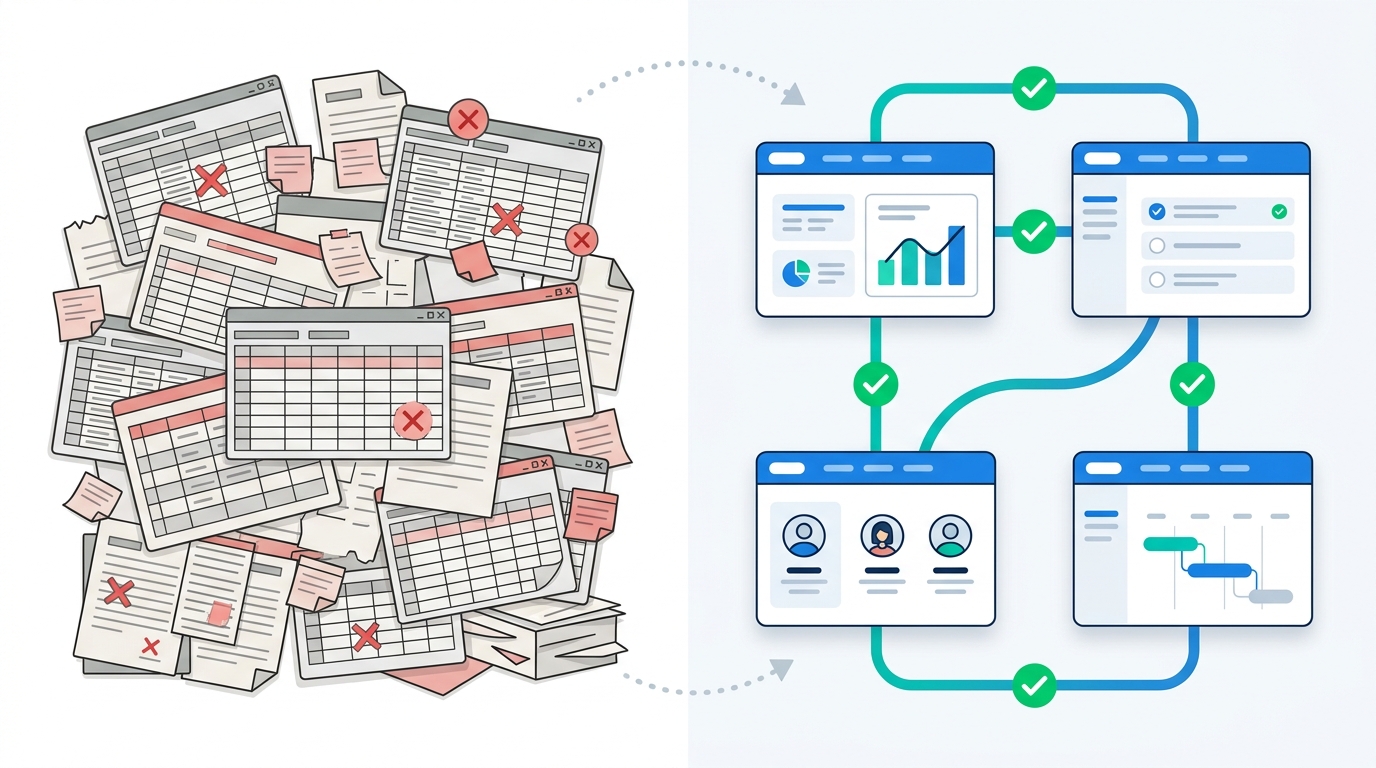
Raj runs a 14-person auto parts export company out of a warehouse in Fremont. He ships brake rotors, suspension components, and engine gaskets to buyers in India, the UAE, and Nigeria. When I first talked to him in September 2025, he had a $2.3 million annual business running on - I'm not exaggerating - a shared Google Sheet with 47 tabs.
Every tab was a different product category. His warehouse guys would update quantities by hand. His sales team in Mumbai would check the same sheet to see what was available. Time zone math meant the sheet was always 8-12 hours behind reality. Raj was losing orders because buyers would get quoted on parts that had already shipped to someone else.
This is a custom web application case study about what happened when we replaced that spreadsheet with something purpose-built. Not a $50,000 enterprise system. Not a SaaS subscription that does 200 things he doesn't need. A focused web app that cost $4,200 to build and paid for itself in seven weeks.
The Problem Nobody Talks About in Custom Web Application Case Study Articles
Most case studies read like press releases. Everything is smooth, the client is thrilled from day one, and the numbers all go up. That's not how it actually works.
Here's what Raj's situation really looked like: He'd tried Zoho Inventory ($249/month for the plan that supported multi-currency). His team hated it. Too many clicks to do simple things. The mobile interface was sluggish on the older Android phones his warehouse crew used. After four months, they quietly went back to the Google Sheet.
He looked at Cin7 ($349/month). Same story - powerful software designed for a different kind of business. Raj doesn't need manufacturing workflows or POS integration. He needs to know how many 55mm brake rotors are on shelf B-14 right now, and he needs his Mumbai team to see that number without refreshing a browser tab.
The real issue wasn't technology. It was fit. Off-the-shelf inventory tools are built for the average of all possible businesses. Raj's business isn't average - it's specific. Export documentation, container load planning, multi-currency invoicing in three different currencies, and a warehouse team that speaks Gujarati and doesn't want to navigate English-language enterprise software.
What We Actually Built: A Custom Web Application Case Study in Plain Language
The system has four screens. That's it. Four.
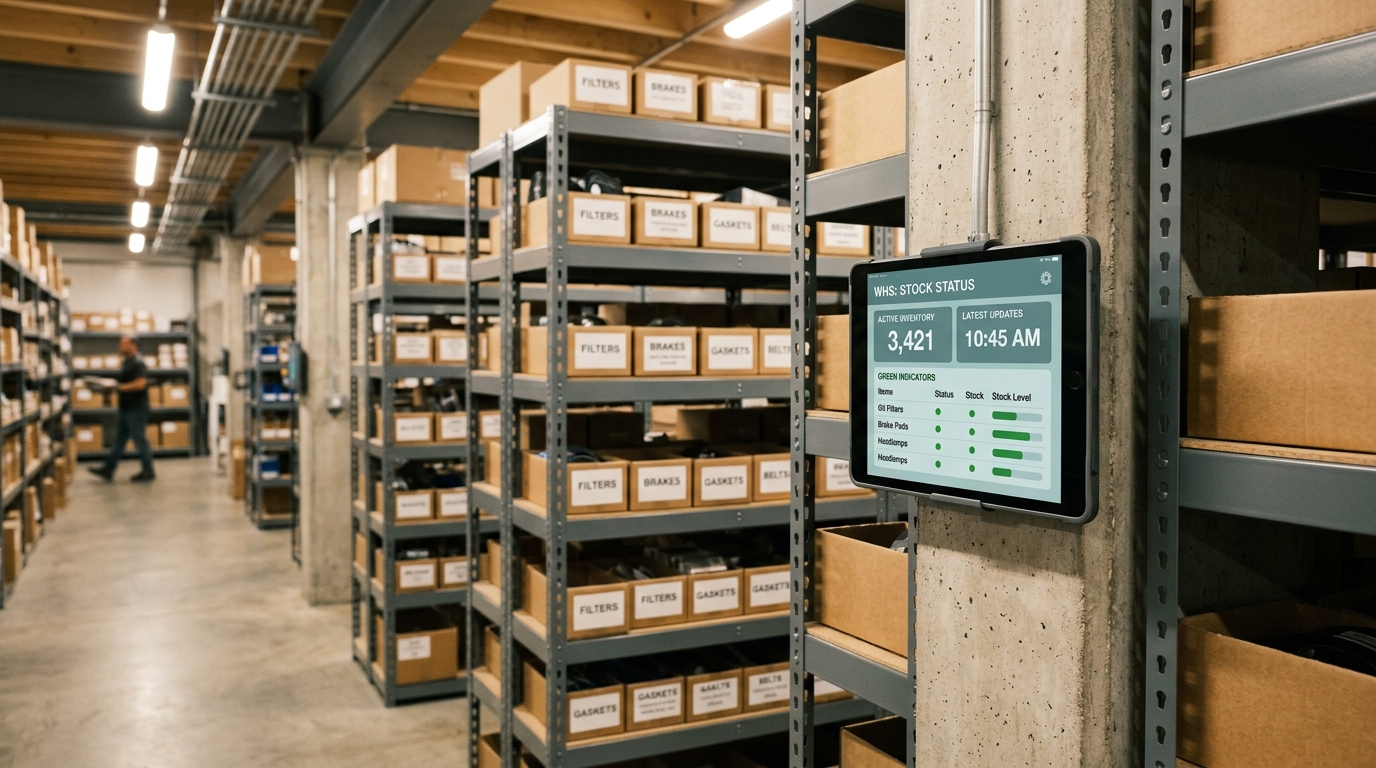
Screen 1: Live inventory dashboard. Every product shows current quantity, last updated timestamp, and a color indicator - green means 50+ units, yellow means under 50, red means under 10. The warehouse team taps a product, types the new count, hits save. Takes about 4 seconds per update. The interface is in Gujarati with English product codes.
Screen 2: Sales view. The Mumbai team sees the same inventory but with pricing in USD, INR, and AED. They can generate a quote PDF in one click with the buyer's name, the current exchange rate (pulled from an API every 6 hours), and Raj's payment terms. When they create a quote, those units get soft-reserved for 48 hours so nobody else quotes the same stock.
Screen 3: Shipping planner. This one saved Raj more money than anything else. Export containers have weight and volume limits. His old process was eyeballing it - sometimes a container would ship half-empty because nobody calculated the remaining cubic footage. The planner shows exactly how much space is left in a 20-foot or 40-foot container as items get added, using the actual dimensions of each product's packaging.
Screen 4: Admin panel. Raj uses this to add products, set prices, manage user access, and pull reports. Nothing fancy - just the stuff he needs.
The whole thing runs on a $12/month VPS. No per-user licensing fees. No annual contracts. The tech stack is PHP, MySQL, and vanilla JavaScript - boring technology that works, loads fast on slow connections (important when your Mumbai office has inconsistent internet), and is easy for any developer to maintain later.
The Numbers Behind This Custom Web Application Case Study
Here's where I have to be careful, because Raj shared his actual financials with me and I want to represent them honestly.
Before the system (Jan - Aug 2025):
- Average monthly revenue: $187,000
- Lost orders due to inventory mismatches: ~12 per month (Raj's estimate based on email threads where he had to tell buyers the quoted parts weren't available)
- Average lost order value: $1,800
- Estimated monthly revenue lost: $21,600
- Container utilization: ~71% on average
After the system (Oct 2025 - Mar 2026):
- Average monthly revenue: $208,000
- Lost orders due to inventory mismatches: 1-2 per month
- Container utilization: 89% on average
- Monthly software cost: $12 (hosting) + ~$2 (exchange rate API)
That's an 11.2% revenue increase. Some of that is market growth - Raj says the UAE market has been strong this year. But he attributes at least 7-8% directly to not losing orders and shipping fuller containers. His words: "I stopped leaving money on the table and money in empty container space."
Honest Pros and Cons
What worked:
- Speed of adoption. Because the interface was designed around how Raj's team already works (not how some product manager in San Francisco thinks they should work), the warehouse crew was using it confidently within two days. No training manual needed.
- Gujarati interface. This sounds like a small thing. It's not. Raj told me his team actually updates inventory now instead of putting it off. The friction of working in a second language was killing compliance with the old tools.
- Container planning. This single feature probably accounts for half the ROI. Going from 71% to 89% container utilization on international shipments is a big deal when you're shipping 6-8 containers a month.
What didn't:
- No offline mode. We didn't build offline capability, and the Fremont warehouse has had two internet outages since launch. During those, the team went back to paper and had to backfill later. If I were doing it again, I'd add a simple service worker cache.
- Reporting is basic. Raj wants trend analysis - which products are moving faster, seasonal patterns, margin by region. The current reports are just filtered tables. Building proper analytics would be a Phase 2 project.
- Single developer dependency. Right now, if something breaks and I'm not available, Raj doesn't have a backup. The codebase is clean and documented, but he should probably have a second developer familiar with it. That's a risk with any custom build.
Custom Build vs. Off-the-Shelf: When Each Makes Sense
I'm not going to pretend custom is always the answer. It's not.
If Raj had a straightforward domestic retail operation - buy products, put them on shelves, sell them to walk-in customers - Shopify's inventory management or even Square would have been fine. $79/month, works out of the box, no development needed.
Custom made sense here because of the combination of specific requirements: multi-currency export pricing, Gujarati language support, container load optimization, and the 48-hour quote reservation system. No single off-the-shelf tool does all four. You could cobble together three or four SaaS products and connect them with Zapier, but now you're paying $500+/month in subscriptions, dealing with sync delays between systems, and praying that none of them changes their API.
The break-even math on Raj's build: $4,200 upfront vs. $349/month for Cin7 (the closest off-the-shelf option, which still wouldn't have handled the container planning or Gujarati UI). The custom build pays for itself in 12 months purely on subscription savings - and that's before counting the revenue impact.
I've built similar focused systems for other Bay Area businesses through my work at Autom84You - a booking system for a San Jose dog groomer, a quote calculator for a Sunnyvale landscaping crew, a client portal for a Palo Alto immigration attorney. The pattern is always the same: the business has outgrown spreadsheets but doesn't fit neatly into any SaaS product's box.
What Makes a Good Candidate for a Custom Build
After doing this for 20+ years, here's my quick filter:
You probably need custom if:
- You've tried 2+ off-the-shelf tools and your team keeps reverting to spreadsheets or paper
- Your workflow has a step that no existing tool handles, and you're doing it manually
- You're paying for 3+ subscriptions that all touch the same data
- Your team speaks a language that most SaaS products don't support well
You probably don't need custom if:
- A single well-known tool covers 90%+ of your needs
- Your processes are still changing - you haven't settled on how you work yet
- Your budget is under $2,000 (the economics rarely work below that threshold)
One More Thing From This Custom Web Application Case Study
Raj told me something in our last check-in that stuck with me. He said, "The software didn't change my business. It just stopped my business from fighting itself." His warehouse team was already good. His sales team in Mumbai was already hustling. The Google Sheet was just making them work against each other - stale data, double-sold inventory, half-empty containers.
Sometimes the highest-impact technology project isn't adding something new. It's removing the friction between the people who already know what they're doing.
AWS just announced AWS Transform for enterprise-scale code modernization, and Microsoft is touting over 1,000 AI transformation stories. Those are great for Fortune 500 companies with six-figure IT budgets. But if you're a 14-person export company in Fremont - or a 6-person plumbing outfit in Campbell, or a solo wedding photographer in Los Gatos - the transformation that matters is the one sized for you.
That's what I do at Autom84You. Custom web applications, AI tools, and automation for small businesses that have specific problems and need specific solutions. Not enterprise software marked down. Not a template with your logo on it. Something built around the way you actually work, at a price that makes sense for your revenue.
If your business is running on a spreadsheet that keeps letting you down, I'd genuinely like to hear about it. Not to sell you anything - half the time I tell people they don't need custom and point them to an off-the-shelf tool instead. But if you're in that sweet spot where you've outgrown the generic stuff and you're losing real money because of it, that's exactly the kind of problem I like solving. nerd@a84y.com - tell me what's breaking and I'll tell you honestly whether it's worth fixing.


Comments
No comments yet. Be the first to share your thoughts!
Leave a Comment