
By the end of this guide, you'll be able to open any competitor's blog, read three paragraphs, and know with reasonable confidence whether a human wrote it or whether they're running ai blog post generation on autopilot. More importantly, you'll know what to do with that information.
Why Bother Detecting AI Blog Post Generation?
Fair question. If a competitor's posts rank and convert, does it matter whether a person or a language model wrote them?
Yes - because it tells you where the gaps are. AI-generated content clusters around the same talking points, the same structure, and the same surface-level advice. If you can identify that pattern, you can write the piece that actually says something. That's the opening.
A wedding photographer in San Jose told me last month that three of her top five competitors started publishing twice a week in early 2026. The posts were long, polished, and utterly interchangeable. She publishes once every two weeks - handwritten, specific to Bay Area venues - and her organic traffic is up 40% since January. Quantity from ai blog post generation doesn't automatically beat quality from a person who knows what they're talking about.
What You Need Before Starting
- Access to your competitor's blog (obviously)
- A free account on OpenAI's playground or any ChatGPT window - you'll use it to compare output patterns
- A notes app or spreadsheet to track what you find
- About 30 minutes per competitor
No paid tools required for steps 1 through 6. Step 7 covers paid detectors if you want a second opinion.
Step 1: Read the First Two Paragraphs Out Loud
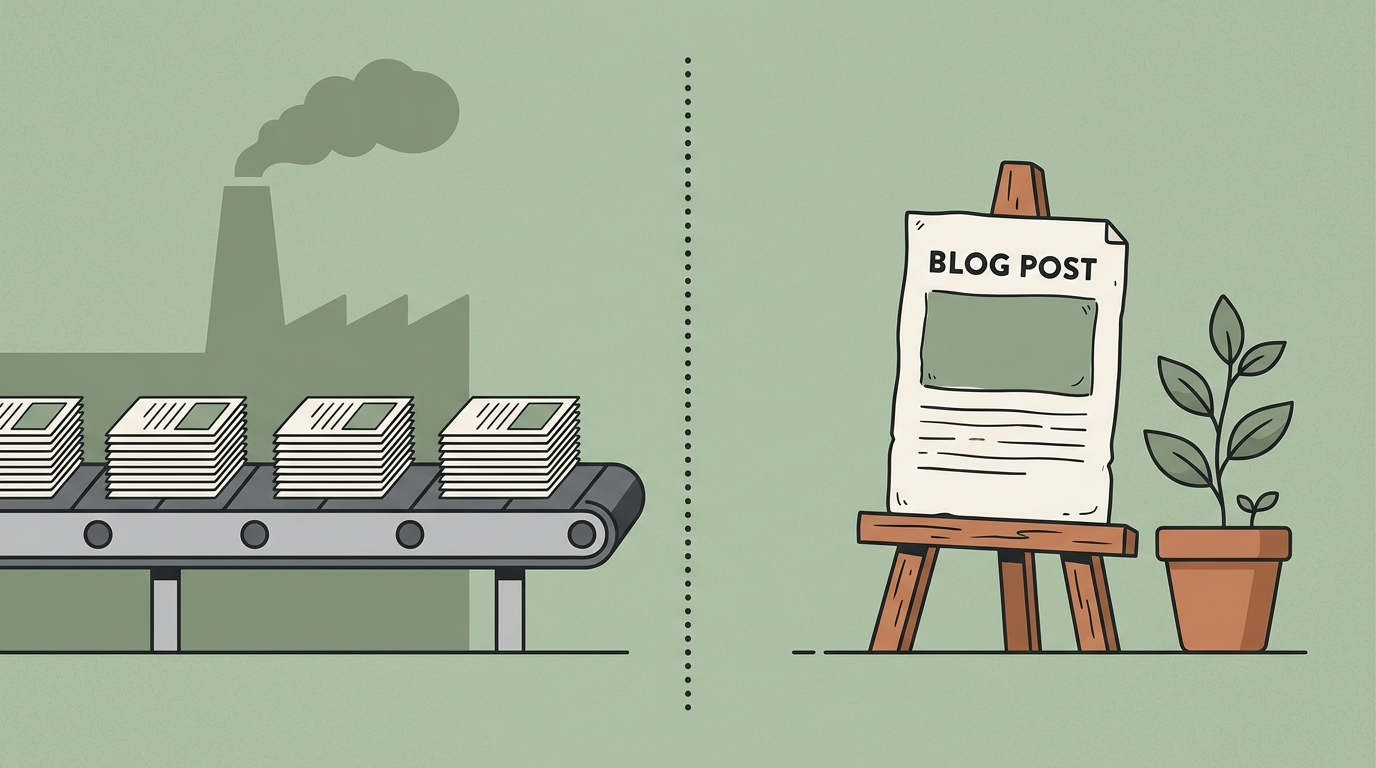
What to note: Does the intro sound like it could open any article on this topic? If you swapped the keyword for a different one and the paragraph still made sense, that's a flag.
Step 2: Search for Specificity
This is the single most reliable tell. Open the article and look for:
- Named businesses, real people, or actual locations
- Exact prices, dates, or version numbers
- Personal anecdotes that couldn't be fabricated from training data
- Screenshots, original photos, or data from a real project
Most ai blog post generation workflows skip all of this because the model doesn't have access to it. You'll see phrases like 'many businesses find that...' or 'according to recent studies...' without naming the study. A dog groomer in Fremont writing about pricing will mention that a standard groom costs $65-$85 in the East Bay. An AI writing the same post will say 'prices vary depending on your location.'
Step 3: Check the Paragraph Structure
Open five posts from the same blog. If every single one follows the pattern of intro → subheading → three paragraphs → subheading → three paragraphs → conclusion, you're likely looking at template-driven ai blog post generation. Humans vary their structure post to post. Some posts are long, some are short. Some have lists, some don't. AI content tends toward mechanical consistency.
Common mistake: Don't confuse a well-organized writer with AI. The difference is that a human's structure serves the argument - an AI's structure serves the template. Look at whether the subheadings build on each other or just sit next to each other like a list of loosely related topics.
Step 4: Run the Synonym Test
AI models rotate synonyms to avoid repetition. You'll see 'utilize,' 'employ,' 'leverage' - scratch that, you'll see 'utilize,' 'employ,' and 'make use of' in the same article because the model is trained to vary word choice. Humans tend to just repeat the same word or use simpler language. If an article about email marketing for taco trucks uses 'culinary entrepreneurs' and 'food service establishments' instead of just saying 'taco trucks,' something is off.
Pull up a ChatGPT window and ask it to write 200 words on the same topic. Compare the vocabulary. You'll often see the same synonym rotation patterns.
Step 5: Look at the Publishing Cadence
Check the blog's archive. If a competitor went from publishing once a month to four times a week starting in mid-2025, and the quality stayed the same or got more generic, they almost certainly adopted ai blog post generation. Nobody quadruples their content output overnight without either hiring a team or plugging in a model.
This isn't a gotcha - it's useful competitive intelligence. A HVAC company in Campbell that publishes 20 generic posts a month is vulnerable to a competitor who publishes 4 genuinely useful ones.
Step 6: Check for Phantom Citations
AI models sometimes reference studies, statistics, or quotes that don't exist. If an article says 'a 2025 Stanford study found that 73% of consumers prefer...' - Google it. If the study doesn't come up, that's a hallucination, and it's a dead giveaway that the content came from a model without human fact-checking.
This also applies to tool recommendations. AI content frequently suggests products with slightly wrong feature descriptions or outdated pricing. If a post recommends a tool and the pricing is off by 30%, a human probably didn't write it - or at least didn't review it.
Tip: Adobe recently launched unlimited generations in Adobe Firefly, and AI content mills are already referencing it with incorrect plan details. Checking current pricing against what an article claims is a quick accuracy test.
Step 7: Paid Detection Tools - the Popular Path and the Alternative
The popular approach is to paste competitor content into a detector like Originality.ai ($15/month), GPTZero (free tier available), or Copyleaks. These tools assign a probability score - 'likely AI-generated' or 'likely human.' They're decent for bulk screening.
The alternative: you don't need them. Steps 1 through 6 give you better signal than any detector, because detectors have a 10-15% false positive rate and struggle with edited AI content. A human who rewrites AI output will fool every detector. But they won't fool your eyes if you know what to look for - the specificity test (Step 2) catches what detectors miss.
If you want both, use a detector for the initial scan and your own judgment for the final call. But if I had to pick one, I'd pick reading closely over paying for a score.
What to Do With What You Find
Here's where this gets practical. If three out of five competitors are running ai blog post generation with minimal editing, you now know:
- Their content is commodity. It covers the same ground as every other AI-written post on the topic. Your opening is depth - real examples, real numbers, real experience.
- Their publishing pace is a weakness, not a strength. Google's helpful content updates since 2024 have consistently deprioritized thin, high-volume AI content. Quality signals - time on page, scroll depth, backlinks - still favor substance.
- Their blog probably isn't connected to their actual business. AI-written posts for a dental office in Sunnyvale will talk about dentistry in general. A post written by someone who actually works with that dentist will mention the specific neighborhood, the parking situation, the type of patients who walk in.
I build content systems for small businesses at autom84you.com - not just blogs, but the full pipeline from topic research to publishing to social distribution. The ones that work best aren't the ones producing the most content. They're the ones where every post has something in it that a model couldn't have written on its own. AI blog post generation is a tool in that process, not a replacement for the thinking.
A Note on Using AI in Your Own Content
None of this means you shouldn't use AI for your own writing. I use Claude for research synthesis, first drafts, and outline generation on most of the projects I build through my portfolio work. The difference between good AI-assisted content and bad AI content is editing. A model gives you raw material. You add the specifics, the voice, the opinion, and the local knowledge that makes it worth reading.
The worst outcome isn't using AI. It's publishing AI output without adding anything to it - because your readers can tell, your competitors can tell, and increasingly, Google can tell.
Quick Reference Checklist
- Generic opening with no specific claim? Flag it.
- No named businesses, people, or places? Flag it.
- Identical paragraph structure across every post? Flag it.
- Synonym rotation instead of natural repetition? Flag it.
- Publishing frequency jumped overnight? Flag it.
- Citations that don't check out? Confirmed.
Three or more flags on a single post and you're almost certainly reading unedited ai blog post generation output.
If you want help building a content strategy that actually holds up against competitors - whether they're using AI or not - reach out at nerd@a84y.com. I'll look at what your competitors are publishing and tell you straight whether you need more content, better content, or a completely different approach. No pitch, just an honest read on where you stand. More about what I do at autom84you.com.




Comments
No comments yet. Be the first to share your thoughts!
Leave a Comment