
Every website has a search bar. Nobody uses it. It's the decorative towel of the internet - technically functional, universally ignored, and when someone actually tries it, everyone ends up disappointed.
You type "pricing" into a small business website and get a blog post from 2019 about "priceless customer relationships." You type "hours" and the About page appears because the word "hours" shows up once in the sentence "we spent hours perfecting our craft." This is the state of site search in 2026. And honestly? A chatbot on site search does the job better. Not because chatbots are magic, but because the bar is literally underground.
Why Your Search Bar Is Basically a Broken Vending Machine
Traditional site search works on keyword matching. It finds pages where your exact words appear and lists them. That's the whole trick. No understanding of what you meant, no ranking by usefulness, no ability to actually answer a question. It's like walking into a hardware store, asking where the plumbing stuff is, and the employee just gestures vaguely at the entire building.
Site search has been this way since roughly 1998. We have self-driving cars and AI that can write poetry, but the search function on your electrician's website still can't find the emergency phone number. The reason most site search is terrible isn't that better technology doesn't exist - it's that keyword search needs a lot of content, good metadata, and proper indexing to work well. Most small business sites have 8 to 15 pages. There's not enough there to index meaningfully.
So the search bar sits there. Decorative. A tiny monument to good intentions.
What Chatbot On Site Search Actually Looks Like
Chatbase is an AI chatbot builder that trains on your website content. You give it your URL, it crawls your pages, and it creates a chatbot that can answer visitor questions using the information it found. No coding required. No complex setup. The whole process takes about ten minutes, which is less time than it takes to explain to your nephew why your current search bar doesn't work.
Pricing is straightforward. The free plan gives you 20 messages per month - basically a demo to see if you like it. The Hobby plan at $19 per month covers 2,000 messages, which is more than enough for most small businesses. Standard runs $99 per month for 10,000 messages if you're getting serious traffic. You embed it on your site with a small snippet of code, and it sits in the corner of your page like a helpful shop assistant instead of a broken vending machine.
What makes this approach to chatbot on site search actually useful is context. Instead of matching keywords, it understands the question. "What time do you close on Saturdays?" gets a direct answer pulled from your hours page - not a list of every page that mentions the word "Saturday" once in passing.
A Dog Groomer's Tuesday With a Site Search Chatbot
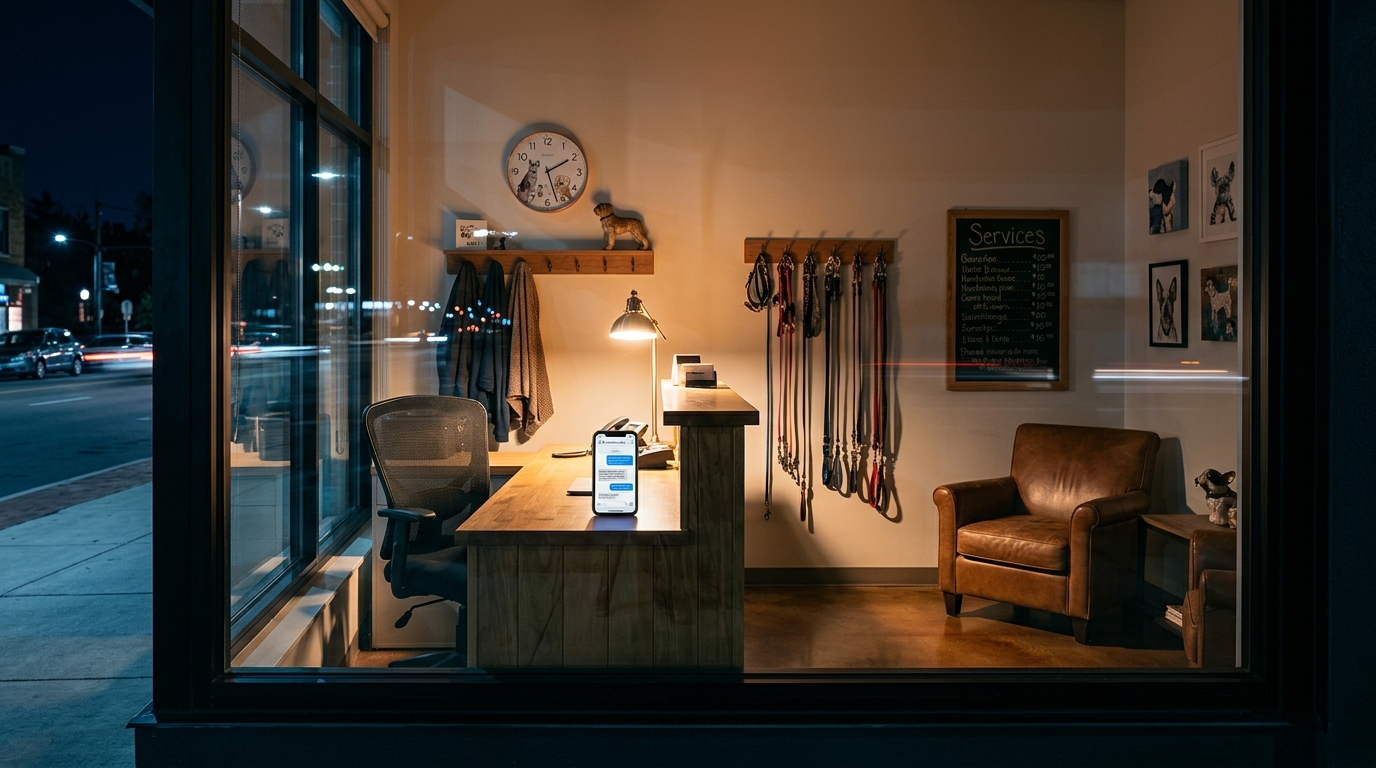
With traditional search, they type "cats" and maybe get your services page. Maybe the blog post where you mentioned a cat once. Maybe nothing. With the chatbot, they type "do you groom cats?" and get: "Yes! We offer cat grooming starting at $65. We recommend scheduling morning appointments for cats, as our salon is quieter before noon. You can book online or call us at (408) 555-0199."
That's the difference. The visitor got an answer, a price, a recommendation, and a next step. At 9 PM. On a Tuesday. While you were three episodes into something on Netflix and not thinking about your website at all.
The chatbot pulled all of that from your existing pages. You didn't write special responses or build a decision tree. You just had the information on your site already, and now it's actually findable. That's what a chatbot on site search gets you - the content you already wrote, finally doing its job.
The Honest Pros and Cons
Pros:
1. Setup is genuinely fast. Ten minutes for a working version. You can spend longer customizing the look and tone, but the basics happen quickly.
2. It works at 9 PM on a Tuesday. And 3 AM on a Sunday. It doesn't get tired of answering "what are your hours" for the 400th time, which makes it more patient than any human on earth.
3. Visitors get actual answers instead of a list of blue links they have to click through and hope for the best.
Cons:
1. It can only know what's on your site. If your pricing page is outdated, the chatbot will confidently share wrong prices with the cheerful certainty of a friend giving bad directions.
2. The free tier is essentially useless for real traffic. Twenty messages per month disappears by lunchtime on day one if your site gets any visitors at all.
3. It occasionally generates answers that sound right but aren't on your site. This is rare, but it happens. As The Guardian recently reported, publishers and businesses are still working through how AI-generated answers handle accuracy and attribution. You'll want to check the conversation logs periodically to make sure your chatbot on site search isn't inventing a Saturday brunch menu you don't actually have.
Two Alternatives Worth Knowing About
SiteGPT starts at $49 per month and does essentially the same thing with a more polished dashboard and better analytics. You pay more, but you get detailed conversation logs showing exactly what visitors are asking - which is genuinely useful if you act on that data. If knowing that 30% of your visitors ask about parking matters to your business, SiteGPT makes that visible.
Tidio has a free tier with paid plans from $29 per month, and it combines live chat with AI chatbot features. It's more of a customer service tool that happens to handle site search, rather than a dedicated AI site search chatbot. Good if you also want live chat during business hours and already have someone who can jump in when the bot gets stuck.
What a Custom Chatbot On Site Search Can Do
Off-the-shelf tools like Chatbase are solid for straightforward websites. But if your business has inventory that changes, appointment availability, or answers that depend on what someone asked two questions ago, a custom-built chatbot does things the $19-per-month option can't.
That's the kind of thing I build at Autom84You - custom AI chatbots starting at $1,000, trained on your actual business data, your voice, your specific workflows. One recent project involved a chatbot for a landscaping company that could answer questions about seasonal service availability and give ballpark quotes based on yard size. You can see that kind of work at the portfolio. The difference between a generic site search chatbot and a custom one is the difference between a vending machine and a bartender who remembers your order.
Here's a practical next step you can take in the next five minutes: go to your own website and use the search bar. Search for something a customer would actually ask. "Do you offer financing?" "What's your cancellation policy?" "Are you open Sunday?" If the results make you wince - or worse, if there are no results at all - you know the decorative towel needs to go.
If you want help replacing it with something that actually works, that's what I do. autom84you.com or nerd@a84y.com. I'll probably relate to whatever's broken.



Comments
No comments yet. Be the first to share your thoughts!
Leave a Comment