
There's a moment in every restaurant owner's life where they open their bank statement, see four separate software charges totaling more than their Tuesday lunch revenue, and whisper "how did we get here" like they're narrating a true-crime documentary about their own P&L.
I had a front-row seat to one of these moments last year. A client - let's call him Mike, because that's his name and he said I could - runs a solid lunch-and-dinner spot in Sunnyvale. Good food, loyal regulars, the kind of place where the server knows your order. Mike's restaurant ordering system situation, though? A horror movie with monthly billing.
The $380 Problem (a.k.a. "Where Is All My Money Going")
Here's what Mike was paying every month just to let people order food online and manage his front-of-house:
Toast POS: $69/month for the base plan, plus payment processing fees that added another ~$90/month at his volume.
ChowNow: $149/month for online ordering so he wasn't handing 30% of every ticket to DoorDash.
A second ordering widget from a company I'd never heard of that charged $72/month and seemed to do... the same thing as ChowNow but worse.
Grand total: roughly $380/month. That's $4,560 a year. For context, that's more than Mike's walk-in refrigerator costs to run annually. He was spending more on software that takes orders than on the box that keeps the food cold.
Mike did what any reasonable person does when confronted with this information: he stared at the ceiling for about ten seconds, then asked me if there was another way.
What a $12/Month Restaurant Ordering System Actually Looks Like
Here's what I built for Mike, and I want to be specific because vague tech claims are the ranch dressing of the internet - everywhere and nobody asked for them.
The custom restaurant ordering system runs on a straightforward stack: a responsive website with an integrated menu and ordering flow, a simple admin panel where Mike or his staff can update items and prices, and order notifications that go straight to the kitchen's tablet and Mike's phone. Orders come in, the kitchen sees them, food goes out. That's it. That's the whole thing.
Hosting runs $12/month on a basic cloud server. Payment processing goes through Stripe at their standard 2.9% + 30¢ - which Mike was already paying through Toast anyway, so that cost is a wash.
No monthly platform fee. No per-order commission. No "premium tier" unlock to get features that should've been included, like the ability to, I don't know, see your own sales data.
A Tuesday in Mike's Life (Before and After)
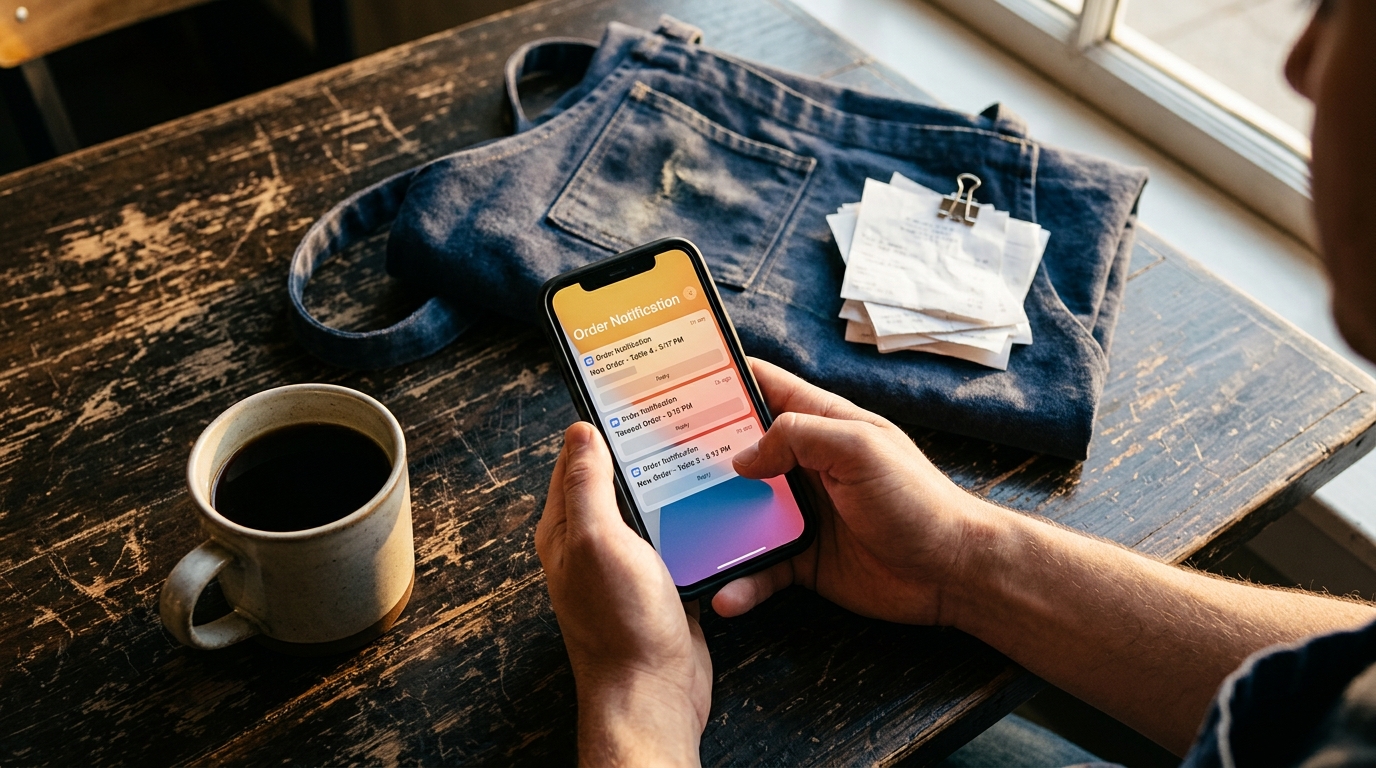
After: A customer visits Mike's website. The menu is right there. They tap what they want, pay with their card, done. The order shows up on the kitchen tablet and Mike's phone simultaneously. Mike gets paid next business day via Stripe. His staff doesn't touch a second system because there is no second system.
Mike told me the first week felt "suspicious" because nothing was going wrong. That's the review I'm putting on my headstone.
The Honest Pros and Cons
I'm not going to pretend a custom build is perfect for everyone. Here's the real deal:
Pros:
- The math is violent. Mike saves over $4,000/year. That's a part-time employee. That's new equipment. That's a vacation where he doesn't check the POS app from the hotel pool.
- He owns everything. His customer list, his order history, his menu data. When ChowNow had that outage last March, Mike's system was fine because it has nothing to do with ChowNow.
- It fits his restaurant specifically. Mike has a build-your-own-bowl option with 23 possible toppings. The old system handled this like a toddler handles a Rubik's Cube. The custom build has a clean grid that customers actually enjoy using.
Cons:
- There's no 1-800 number. If something breaks, Mike calls me. I'm responsive, but I'm one person, not a support department with hold music and a chatbot named "Alex."
- The upfront cost is real. Building a custom system costs more than signing up for a SaaS plan. Mike's build ran a few thousand dollars - it paid for itself in under a year, but you do need that initial investment.
- You don't get the DoorDash marketplace. A custom restaurant ordering system handles direct orders beautifully. It doesn't list you on a third-party app where people discover new restaurants. Mike kept a DoorDash listing for discovery but funnels regulars to his own site with a small discount.
How This Compares to the Big Names
According to a recent Restaurant Technology News report, most restaurant POS platforms still lack cross-system intelligence - meaning your ordering system, your POS, and your customer data often live in three different universes that don't talk to each other. That's not a bug; it's a business model. More tools = more subscriptions = more revenue for the vendor.
Toast is genuinely good hardware with genuinely aggressive upselling. You start at $69/month and end up at $200+ once you add online ordering, marketing, and loyalty features. Square for Restaurants is simpler and cheaper, starting free for the basic tier, but the per-order fees add up fast if you do any real volume. Both are fine products that make a lot of money by making sure you never stop paying.
A custom build makes sense when you're established enough to have steady order volume and you're tired of watching your margins get nibbled by four different monthly charges. For a brand-new restaurant still figuring out their menu? Probably start with Square's free tier and graduate later.
The Part Where I Mention This Is What I Do
Yeah, I build these. Autom84You is my one-person shop - I do custom websites starting at $500, and more complex builds like Mike's ordering system at $75/hour. I've also been building AI chatbots for restaurants that handle the "is the patio open" and "do you have gluten-free options" questions so the staff doesn't have to answer the phone during the dinner rush. Those start at $1,000 and get trained on the restaurant's actual menu and policies.
I'm not going to tell you that every restaurant needs a custom ordering system. Some don't. But if you're a restaurant owner staring at $300+ in monthly software fees and thinking "there has to be a better way" - there is, and it's less complicated than you'd expect.
The online ordering market is growing fast, which means more platforms fighting for your monthly subscription. You can keep being the product, or you can own the product. Mike chose door number two and his only regret is not doing it sooner. His words, not mine. Okay, also mine.
If you want to talk through whether a custom build makes sense for your place, shoot me a note at nerd@a84y.com or check out autom84you.com. No pitch, no pressure - just a nerd who likes solving restaurant math problems and will probably order something off your menu while we're at it.


Comments
No comments yet. Be the first to share your thoughts!
Leave a Comment