
The Chatbot That Answered Everything Except What Mattered
A dentist in Campbell, California, installed a popular chatbot widget on her website last March. It cost $29/month. It could tell visitors her office hours, her address, and the names of her hygienists. What it could not do: tell a nervous parent whether their 4-year-old's chipped tooth needed an emergency visit or could wait until Monday.
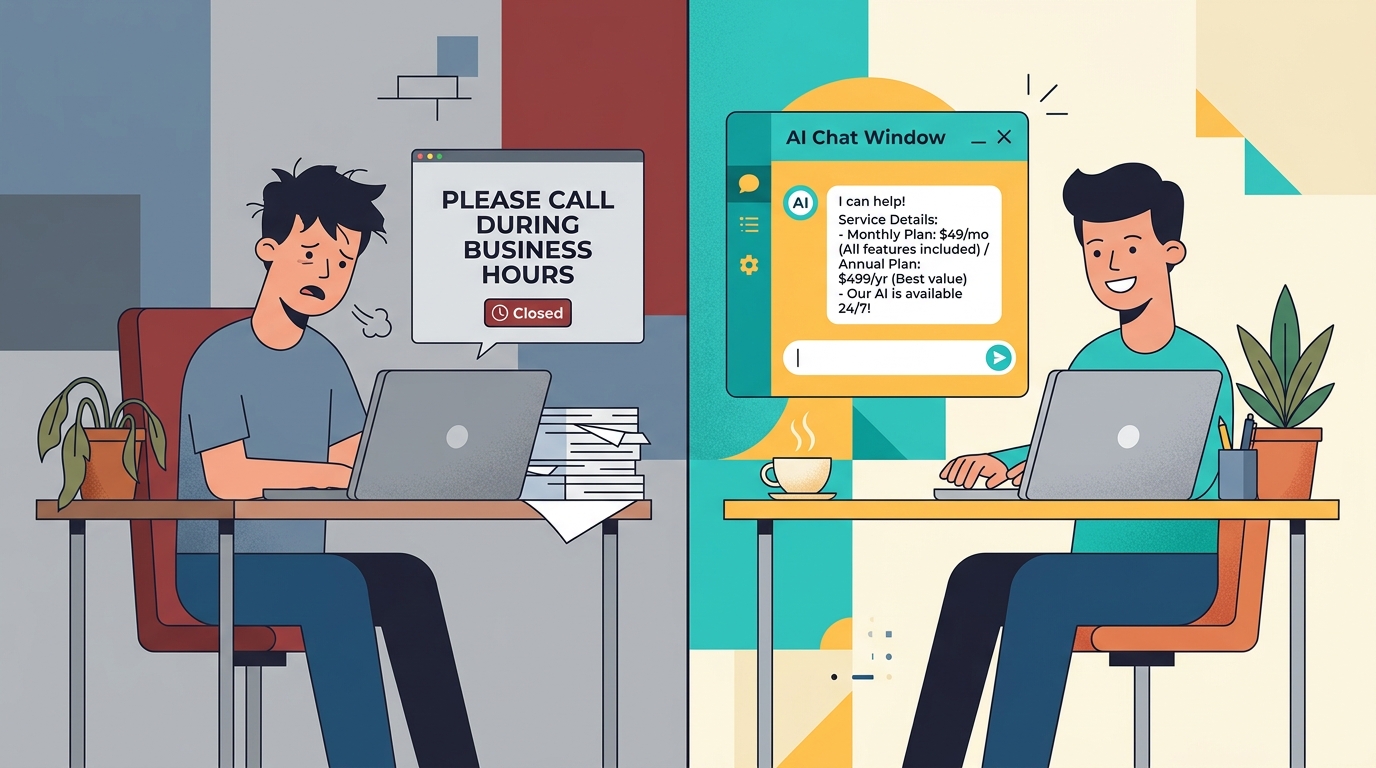
That question came in 11 times in one month. Every single time, the chatbot spit out a canned response: "Please call our office during business hours." Seven of those messages came in after 6 PM or on weekends - when nobody was answering the phone. Those parents went to Google, found another dentist with better answers, and never came back.
She didn't have a chatbot problem. She had the wrong chatbot. And if you've been searching for a custom AI chatbot for my website that actually understands your business, you've probably already figured out that most off-the-shelf options don't.
What a Custom AI Chatbot for My Website Actually Means in 2026
Let's get specific, because this term gets thrown around loosely. A custom AI chatbot is not a decision-tree flowchart with pre-written answers. It's not a generic ChatGPT embed with your logo slapped on it. It's a conversational AI agent trained on your data - your services, your pricing, your FAQ, your policies, your inventory, your service area - that can hold a real conversation with a visitor and give answers that are actually correct for your business.
The difference matters. A generic widget knows what a dental cleaning is. A custom AI chatbot knows that your office does Saturday cleanings, that your new patient exam costs $89 without insurance, and that you accept Delta Dental but not Cigna HMO. It knows because someone fed it that information and tuned it to respond in your voice.
The technology underneath is usually a large language model - Claude, GPT-4, Gemini - connected to a knowledge base built from your website content, documents, and sometimes your CRM or booking system. The model handles the conversation. The knowledge base keeps it honest.
Real Numbers: What Happens When the Bot Actually Knows Your Business
I built a custom AI chatbot for a mobile auto detailer in Sunnyvale last fall. He had a WordPress site getting about 400 visits a month, mostly from Google. His old setup: a contact form and a phone number. His conversion rate from visitor to booked job was around 2.1% - about 8-9 bookings a month from the website.
We trained the chatbot on his full service menu, pricing (including the $45 upcharge for SUVs, which confused people constantly), his service radius, his availability calendar, and his cancellation policy. The bot could answer questions like "Do you come to apartment complexes?" and "What's the difference between your $120 and $200 packages?" with specifics, not vague deflections.
Within 60 days, his website conversion rate hit 6.4%. That's not 3x because of some marketing magic - it's 3x because visitors who had questions at 10 PM on a Tuesday actually got answers instead of bouncing. The chatbot collected their name, phone number, and service interest as part of the conversation. He woke up to leads in his inbox instead of missed opportunities.
That's what a custom AI chatbot for my website looks like when it's done right. Not a novelty. A salesperson who never clocks out.
Who Makes These, What They Cost, and What to Watch Out For
You've got three tiers in the market right now:
DIY platforms ($20-$100/month): Tools like Tidio, Intercom, Drift, and Chatbase let you upload documents and create a bot without writing code. Tidio's AI plan starts at $29/month. Chatbase starts free but caps at 20 messages/month - the $19/month plan gets you 2,000. These work if your needs are simple and you're willing to spend a weekend configuring things. The catch: you're limited to what their platform allows. If you want the bot to check your Google Calendar or pull pricing from a spreadsheet, you're probably out of luck.
AI-native builders ($100-$500/month): Platforms like Voiceflow, Botpress, and Stack AI give you more power - API integrations, custom workflows, conditional logic. Voiceflow's pro plan runs $100/month. These are solid if you have someone technical on your team or you're comfortable learning a new tool. The learning curve is real, though. I've seen business owners sign up, spend three Saturdays on it, and end up with something that still hallucinates their pricing.
Custom-built ($1,000-$5,000 one-time + hosting): Someone builds it specifically for you. Trains it on your data. Connects it to your systems. Tests it. Deploys it. This is what I do at Autom84You - custom AI chatbots and agents starting at $1,000, trained on the business's actual content, pricing, and workflows. The advantage is obvious: it works on day one because someone who builds these for a living made the decisions you'd spend weeks figuring out. The disadvantage: it costs more upfront.
A Day in the Life: How a Plumber in San Jose Uses His
Mike runs a two-person plumbing operation. His website gets about 600 visits a month. Before the chatbot, his lead flow was simple: people called, or they didn't. After hours, he lost every potential customer who wasn't willing to leave a voicemail (which is almost everyone under 45).
His custom AI chatbot for my website - well, his website - handles three things:
1. Qualification. Someone types "My water heater is leaking." The bot asks: "Is water actively flowing, or is it a slow drip? How old is the unit?" Based on the answers, it either flags it as an emergency (and texts Mike directly) or books a next-day estimate.
2. Pricing transparency. "How much to unclog a drain?" The bot responds: "Mike's standard drain clearing starts at $175 for a single fixture. If it requires a camera inspection, that adds $95. Most jobs come in under $250." No dodging, no "it depends" without context. Real numbers from Mike's actual price sheet.
3. Lead capture. Every conversation where the visitor asks about a specific service ends with the bot collecting a name, phone number, and preferred callback time. Mike gets an email with the full conversation transcript. He calls them back knowing exactly what they need.
Mike told me he booked $4,200 in jobs last month from after-hours chatbot conversations alone. His total investment: $1,200 for the build, $30/month for hosting and the API costs.
Pros and Cons - No Sugarcoating
Pros:
1. 24/7 lead capture that actually converts. Not a form that sits there. A conversation that qualifies and collects information the way a good receptionist would.
2. Answers stay accurate to YOUR business. Unlike generic AI, a custom-trained bot won't make up pricing or services you don't offer - as long as the knowledge base is maintained.
3. Pays for itself fast. If your average job is $200+ and the bot captures even 3-4 extra leads per month, the math works in month one.
Cons:
1. It's not set-and-forget. When you change your pricing, add a service, or stop serving a zip code, someone needs to update the bot's knowledge base. Stale data means wrong answers, and wrong answers mean lost trust.
2. Some visitors hate chatbots on principle. A University of Cincinnati study found that people preferred AI-generated responses - until they were told AI wrote them. Perception is a real obstacle. A well-built bot should feel helpful, not pushy. If the first thing a visitor sees is an aggressive popup, you've already lost.
3. Complex questions still need a human. The bot handles 80% of conversations well. The other 20% - unusual situations, emotional customers, complaints - need to route to a real person. If there's no escalation path, you're creating a worse experience than having no bot at all.
How It Stacks Up Against the Alternatives
Vs. Tidio ($29/month): Tidio is fine for basic FAQ automation. Their AI chatbot can pull from your website content automatically, which is convenient. But it struggles with nuance - it won't know that your $200 service doesn't apply to commercial properties, or that you're booked out two weeks for interior work. For a simple retail site, Tidio works. For a service business with conditional pricing and scheduling, you'll outgrow it fast.
Vs. Chatbase ($19-$99/month): Chatbase is probably the best DIY option right now. You upload your documents, it builds a bot, you embed it. The quality is decent for the price. Where it falls short: no native integrations with booking systems or CRMs, limited conversation design, and you're responsible for prompt engineering - which sounds simple until your bot starts confidently quoting prices you changed six months ago.
A custom build costs more but eliminates the guesswork. You get something that works for your specific business on day one, with an escalation path to a human and integrations that actually talk to your systems. I've set up bots that pull live availability from Google Calendar and push leads directly into a client's CRM - try doing that with a $19/month tool.
What to Do Right Now
If you're a service-based business getting at least 200 website visitors a month and you're not capturing leads after hours, a custom AI chatbot for my website is one of the highest-ROI investments you can make. Not because the technology is magic - because right now, your competitors' websites are just as dead after 5 PM as yours is.
Start here: look at your Google Analytics (or whatever you're running) and check how much of your traffic comes in between 6 PM and 8 AM. For most local service businesses, it's 40-60%. That's your opportunity window. Every one of those visitors who has a question and gets no answer is someone driving your cost-per-lead up by leaving without converting.
If you want to try the DIY route, Chatbase is the one I'd recommend starting with. Upload your core pages, test it for two weeks, see if the quality of answers meets your standard.
If you'd rather have it done right the first time - or you tried the DIY approach and the bot keeps saying things that make you cringe - that's the work I do. I build custom AI chatbots for small businesses, trained on your actual services, pricing, and policies. You can see examples at autom84you.com/pages/portfolio.php. Or just tell me what kind of business you run and I'll tell you honestly whether a chatbot makes sense for you: nerd@a84y.com.
No pitch. Just an honest answer from someone who's built enough of these to know when they're worth it - and when they're not.


Comments
No comments yet. Be the first to share your thoughts!
Leave a Comment