
There's a kitchen cabinet shop in Fremont that pulled $412,000 through its website last year. The entire operation - product catalog, quote requests, scheduling, invoice generation, SMS confirmations - runs on a $5 per month Hetzner VPS. One virtual machine. 2 GB of RAM. The owner calls it 'the toaster' because it sits in the same digital spot, does one job, and never breaks.
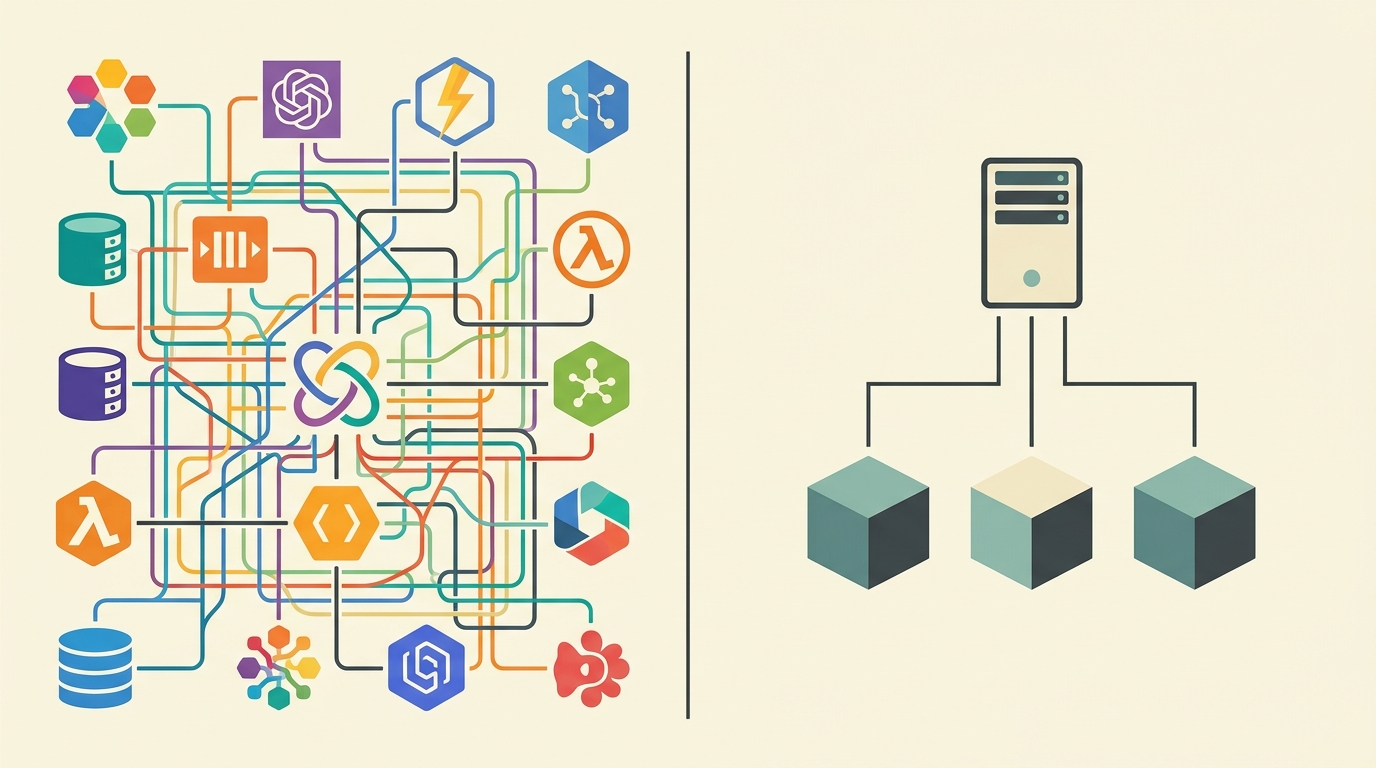
The myth about boring tech small business infrastructure is that it can't handle real traffic, can't scale, and will fall over the moment someone shares your site on Reddit. Pick up any startup subreddit or YC-adjacent Twitter feed and you'll hear the same advice: you need Vercel and Supabase and a Cloudflare Workers layer and probably Clerk for auth. The boring answer - a single Linux server running nginx, a database, and some PHP or Node - is treated like a relic. It isn't.
Why the myth sticks
People believe this for reasons that are almost entirely fair. Modern platforms ship with real advantages. Vercel's preview deploys are genuinely useful for agencies pushing out 40 client sites a year. Supabase's row-level security saves you from writing auth middleware by hand. Serverless scales to zero, which matters when you're a solo founder and your idea might get written up in TechCrunch on Tuesday and forgotten by Thursday. Conference talks celebrate these tools because the engineers giving the talks actually work on workloads where those tools earn their keep.
The problem is that the advice leaks. A dog grooming business in San Jose does not have TechCrunch-shaped traffic. A roofing contractor does not need edge functions running in 300 cities. But the guidance written for the hypothetical hypergrowth founder gets applied to the actual dentist trying to take online bookings, and her $40 a month 'simple stack' becomes $340 a month by year two as add-ons pile up.
The boring tech small business reality
A $5 per month Hetzner CPX11 gives you 2 vCPUs, 2 GB of RAM, 40 GB of SSD, and 20 TB of bandwidth. That is not a toy. nginx on that box will serve 8,000 to 10,000 requests per second for cached HTML. MySQL will happily handle 500 simultaneous connections without flinching. If your bakery's website somehow got 10,000 visitors in a single hour - an absurd scenario for a neighborhood bakery - the server would barely wake up.
For context: the average independent small business website sees somewhere between 200 and 5,000 visitors per month. Not per hour. Per month. The gap between what a $5 VPS can handle and what a real small business actually needs is roughly three orders of magnitude. You're not outgrowing it. You're not scaling beyond it. You're using about 0.3% of what you're paying for.
While Meta is raising Quest 3 prices by $100 because of a global memory shortage, server RAM at the VPS tier has barely budged in price. The hardware running boring tech small business setups has quietly gotten more powerful every generation while the monthly bill stays flat. SaaS subscriptions only go the other direction.
Three shops proving the point
A taco truck collective in Oakland with three locations runs menus, mobile ordering, SMS loyalty, and daily schedule updates on one $10 Vultr VPS. The owner's nephew wrote the original PHP in 2019. It's been updated twice since. Handles 400 to 600 orders a day across the trucks. No Stripe Connect subscription, no Shopify, no mobile app. Just a page, a form, and a webhook to the kitchen's thermal printer.
A wedding photographer in Santa Cruz hosts client galleries - 800 to 1,200 high-resolution proofs per wedding - on a Hetzner VPS paired with an S3-compatible object storage bucket. Clients browse, favorite, order prints. The same box runs her blog, her booking calendar, and her email newsletter. Total monthly infrastructure: under $15. Squarespace had quoted her $480 a year just for the base site, plus storage overages, plus an add-on for galleries.
When the expensive stack actually earns its money
The boring tech small business argument is not that modern infrastructure is bad. It's that it's usually oversized for the job. Vercel and Supabase and the whole serverless world start to make real sense when you have traffic spikes of 50x in an hour, when you genuinely need compute at the edge, when you're running an AI product with unpredictable LLM costs, or when you have a team of six engineers and the operational burden of a VPS actually costs more than the subscription savings.
For a plumbing company in Fremont with 340 unique visitors a month? A Hetzner box, nginx, and a WordPress install will outlive the plumber's career.
How to start with a boring tech small business stack
If you're paying $120 or more per month for tools that feel like overkill, the honest first step is to list what you actually need: a site, a form that emails you, maybe a database, maybe a scheduled job or two. Ninety percent of small business sites need nothing else.
I've built stacks like this for shops across the Bay - the portfolio at autom84you.com has a few of them. A single VPS, nginx, a database, clean code, and a cron job or two. Custom builds start around $500 at autom84you.com, and the infrastructure they run on costs less than a sandwich per month for the lifetime of the business. If you want marketing links with QR tracking layered on top, links.autom84you.com plugs in without adding yet another SaaS subscription.
If you want someone to look at what you're paying for right now and tell you honestly whether the boring tech small business route fits your situation - or whether yours is one of the cases where the expensive stack actually earns its keep - nerd@a84y.com. No pitch. Just a second opinion.


Comments
No comments yet. Be the first to share your thoughts!
Leave a Comment