
A ceramicist in San Jose told me she sold $38,000 on Etsy last year and kept about $31,000 after fees, ads, and offsite ad deductions she never opted into. That's $7,000 gone - roughly the cost of a nice kiln. She didn't hate Etsy. She just started wondering what $7,000 buys if you spend it differently.
That question - what comes after the marketplace? - is one I hear from jewelers, illustrators, woodworkers, and textile artists across the Bay Area. They've outgrown the marketplace model but don't know what an artist shop website actually looks like when it's not Etsy, not Shopify, and not a $15,000 agency build.
This post is for them. And maybe for you.
Why Etsy Works (And Why Artists Still Leave)
Credit where it's due: Etsy is a genuinely good launchpad. You list a product, and within days, strangers find it through Etsy's search. No SEO knowledge required, no ad budget, no tech skills. For a first-time seller, that's magic.
But here's what changes over time. Etsy's fee structure has grown. Transaction fees sit at 6.5%. Payment processing adds another 3% + $0.25. If Etsy's offsite ads program drives a sale, that's another 12-15% on top. Listing fees are $0.20 each, and if you want any visibility in 2026, you're running Etsy Ads too. A seller doing $3,000/month can easily lose $400-500/month to the platform.
Then there's the brand problem. Your shop lives inside Etsy's design. Your URL is etsy.com/shop/YourName. Your customers get emails from Etsy, not from you. When someone searches your shop name, Etsy's SEO outranks you - so competitors show up alongside your listing. You're building someone else's brand equity with every sale.
None of this makes Etsy bad. It makes Etsy a starting point, not a destination.
What an Artist Shop Website Actually Costs in 2026
The fear most artists have is that a custom website means $10,000 upfront and $300/month in hosting. That was true in 2012. It's not true now.
Here's a realistic breakdown for a working artist shop website:
Option A: Squarespace Commerce - $33/month ($396/year). Includes hosting, SSL, basic e-commerce. Transaction fees: 0% on their Business plan if you use Stripe (which charges 2.9% + $0.30). Templates are decent. Customization is limited but workable for most artists.
Option B: Shopify Basic - $39/month ($468/year). Better e-commerce tools, more apps, stronger inventory management. Transaction fees: 2.9% + $0.30 through Shopify Payments. More flexibility, but the app ecosystem can get expensive fast - $10 here, $20 there, and suddenly you're at $100/month in add-ons.
Option C: Custom-built site - $500-2,000 one-time, plus ~$100-200/year for hosting and domain. Payment processing through Stripe at 2.9% + $0.30. No monthly platform fee. No app subscriptions. You own everything. This is the path almost nobody markets to artists, because there's no recurring revenue for the person recommending it.
I've built option C for a few artists and makers through my studio. A printmaker in Campbell needed a gallery with built-in purchasing - twelve pages, Stripe checkout, automated order confirmations. Total build cost was under $800. Her annual running cost is about $150. Compare that to the $468/year minimum on Shopify before any apps.
How a Custom Artist Shop Website Works Day-to-Day
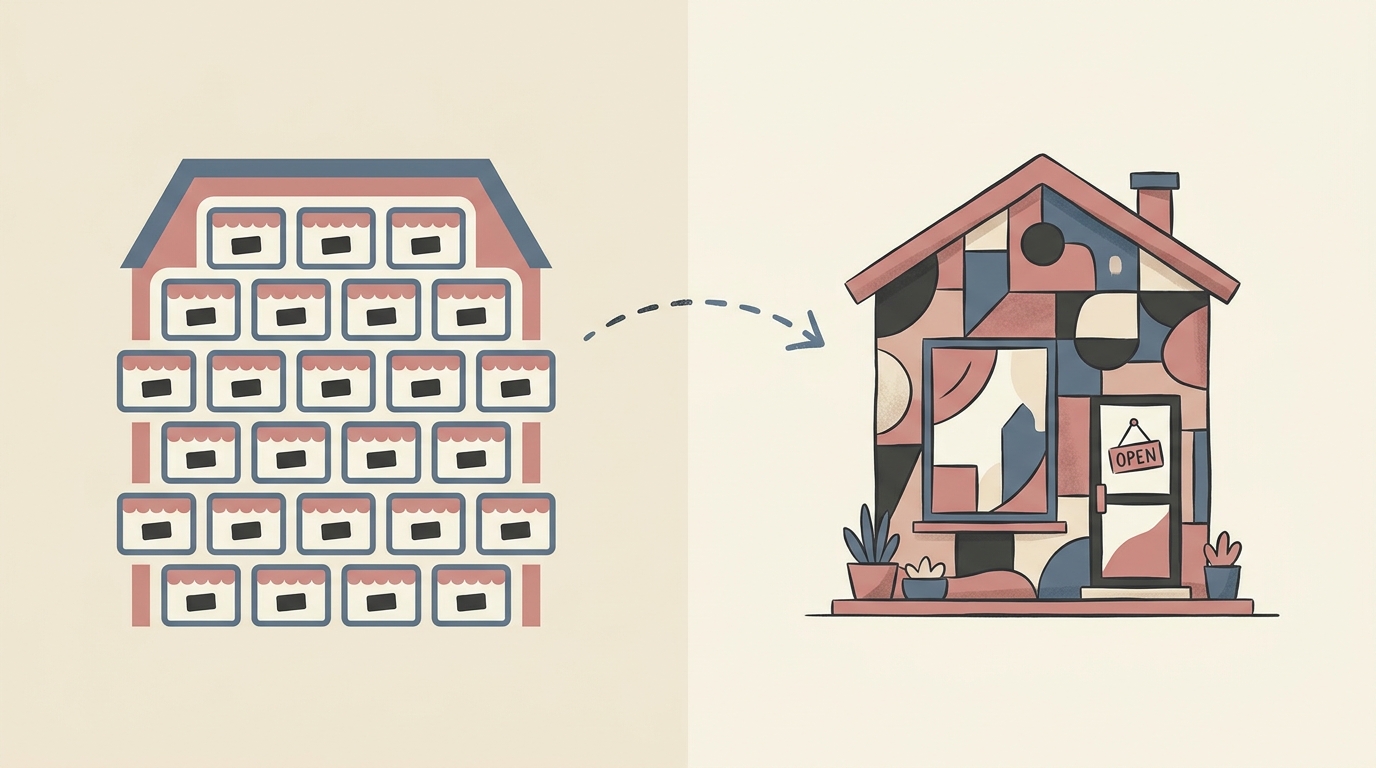
On a custom artist shop website, your daily workflow looks like this:
Morning: You finished a new piece last night. You photograph it, crop and color-correct in your phone's editor, and upload it to your site's admin panel. You set the price, write a two-sentence description, and hit publish. Total time: 8 minutes.
Midday: Someone buys a $45 print. Stripe processes the payment. You get an email with the order details and shipping address. Your site automatically sends the buyer a confirmation with an estimated shipping window. You pack and ship when you're ready - no platform nagging you about handling time metrics.
Evening: You share the new painting on Instagram with a link to your site (your domain, your brand, your SEO juice). Someone clicks through, doesn't buy today, but your site drops a cookie. Next week, you can retarget them with a $5 Facebook ad. Try doing that with Etsy - you can't, because Etsy owns that customer data.
That last point matters more than most artists realize. On Etsy, you rent your audience. On your own artist shop website, you own it.
The Honest Pros and Cons
Pros of going custom:
1. Lower long-term cost. After the initial build, you're paying $100-200/year versus $400-600/year on platforms - and zero marketplace commission on top of that.
2. You own your customer list. Email addresses, purchase history, browsing behavior. This data lets you market directly to people who already like your work instead of paying a platform to reach them.
3. Brand control. Your domain, your design, your aesthetic. A potter's site should feel like clay and earth, not like a marketplace listing sandwiched between phone cases and stickers.
Cons of going custom:
1. No built-in traffic. Etsy brings buyers to you. A standalone site means you need to drive your own traffic - Instagram, email newsletters, local art walks, word of mouth. This is real work.
2. You're the IT department. Something breaks at 11pm? That's on you (or whoever built your site). Platforms handle uptime, security patches, and payment compliance automatically.
3. Setup takes more thought. A marketplace listing takes 10 minutes. A custom site takes planning - what pages you need, how your gallery is organized, what your checkout flow looks like. It's front-loaded effort.
For artists doing under $500/month in sales, Etsy probably still makes sense. The built-in audience is worth the fees at that scale. But once you're consistently above $1,500-2,000/month, the math shifts hard toward owning your platform.
What About TikTok Shop?
Worth mentioning since The Art Newspaper reported that TikTok Shop added a fine art category. The pitch is appealing - massive audience, built-in video commerce, younger buyers.
The reality: TikTok Shop's commission is 5% + payment processing, which is slightly better than Etsy on fees. But you're even more dependent on the algorithm than on Etsy. Your shop visibility lives and dies by whether TikTok decides to show your content this week. And you still don't own your customer data.
TikTok Shop makes sense as a channel - a place to post video of your process and link back to your own site. It doesn't make sense as your only storefront. Same applies to Instagram Shopping, Facebook Marketplace, and any other platform where someone else controls the algorithm between you and your buyer.
Squarespace vs. Shopify vs. Custom: Quick Comparison for Artists
Squarespace is the middle ground. Beautiful templates, reasonable pricing, decent for artists who want something polished without learning code. Limitation: e-commerce features are basic compared to Shopify, and customization hits a wall fast if you want anything non-standard.
Shopify is the power tool. Best for artists who also run a serious retail operation - high volume, multiple product lines, wholesale accounts. Limitation: the monthly cost creeps up with apps, and the default themes look more "retail store" than "artist studio" without significant customization.
Custom-built is the long game. Best for artists who want a site that looks exactly like their work feels, with no ongoing platform fees eating into margins. Limitation: you need someone to build it, and you need a basic plan for driving traffic.
My honest take: if you're selling fewer than 20 items and just want something live this weekend, start with Squarespace. If you're running a full operation with inventory and shipping logistics, Shopify earns its fee. If you want something that's truly yours - your design, your data, your rules - a custom artist shop website pays for itself within the first year.
One More Thing Worth Considering
A lot of artists I talk to spend hours on social media trying to drive sales. That time has value. One thing I've been building for clients lately is lightweight marketing automation - a QR code on your business card at art fairs that tracks which events actually drive site visits, automated email sequences when someone buys their first piece, that kind of thing. The tools exist to make a one-person art business run like it has a marketing team. They just don't get talked about in the usual "how to sell art online" advice.
Your Next Step
If you're on Etsy now and curious about what your own artist shop website would look like, here's what I'd actually do today: open a spreadsheet, pull your last 12 months of Etsy fees from your payment account, and add them up. That number is your annual "rent" on someone else's platform. Then ask yourself what you'd do with that money if you kept it.
If the answer is interesting enough to explore, I'm happy to look at your current setup and tell you honestly whether a move makes sense or whether Etsy is still your best bet. No pitch, just a straight answer. autom84you.com or nerd@a84y.com - I build these for artists and makers regularly, and sometimes the right advice is "stay where you are for now."




Comments
No comments yet. Be the first to share your thoughts!
Leave a Comment