
A tattoo artist in Sacramento asked me last month if she needed to put a disclaimer on her website because she uses ChatGPT to write her aftercare instructions. A property manager in Stockton wanted to know if his AI-generated listing descriptions could get him fined. A gym owner in Modesto heard something about an 'AI law' and panicked.
All three had the same question: am I about to get in trouble for using AI in my business?
The short answer is probably not - but the longer answer matters, because the regulatory ground is shifting fast and some of these rules will absolutely affect how you run things. Here are the three biggest developments worth paying attention to.
The White House Dropped a National AI Policy Framework
The White House released its National Legislative Policy Framework for Artificial Intelligence earlier this year, and it's the clearest signal yet that federal AI rules are coming - not someday, but soon. The framework lays out priorities for Congress: transparency requirements, accountability standards, and sector-specific guidelines for how AI gets used in hiring, lending, healthcare, and housing.
For a flooring company or a dog groomer, this might sound like background noise. But here's the part that matters: if you use AI tools that touch customer data, hiring decisions, or pricing, you're in scope.
Specifically, the framework pushes for disclosure requirements. If a customer is interacting with an AI chatbot on your website instead of a human, you may need to say so. If you're using AI to screen job applicants - even through a third-party tool like an applicant tracking system - there could be documentation requirements.
The framework isn't law yet. But it's the blueprint that legislation will follow, and several bills are already being drafted around it. The smart move is to start paying attention now rather than scrambling later.
What to do about it: Audit where you're using AI. Write it down. If you have a chatbot, make sure it identifies itself as automated. If you use AI for hiring, check whether your tools have a bias audit or compliance report - most of the major platforms are already building these in.
State-Level AI Laws Are a Patchwork - And That's the Problem
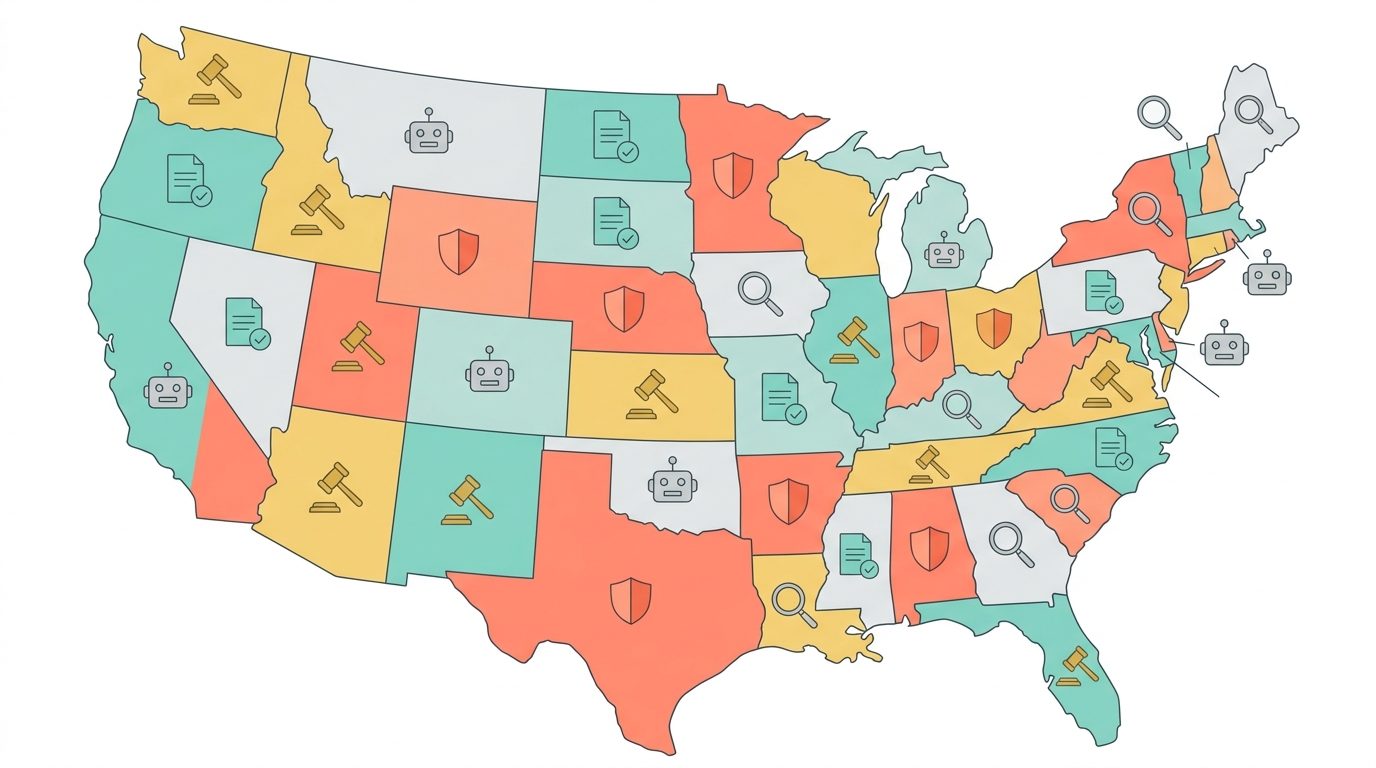
While Washington debates frameworks, states aren't waiting. Colorado's AI Act is now in effect, requiring businesses that use 'high-risk' AI systems to notify consumers and conduct impact assessments. California has multiple AI bills working through the legislature, including requirements around AI-generated content disclosure and restrictions on AI in employment decisions. Illinois already requires consent before using AI to analyze video interviews of job candidates.
If you're a California small business, this hits closest to home. The proposed rules would require you to disclose when customers are interacting with AI-generated content - think marketing emails written by Claude, product descriptions generated by GPT, or automated responses on your social channels.
Here's what makes this messy for a two-person landscaping crew or a solo wedding photographer: the rules vary by state, and if you serve customers across state lines - even digitally - you might be subject to multiple sets of rules. An e-commerce store in Fresno selling candles to customers in Colorado is technically subject to Colorado's AI Act if they're using AI systems that fall under its 'high-risk' definition.
Now, enforcement against small businesses has been essentially zero so far. Regulators are focused on big tech and large employers. But the laws exist, and 'I didn't know' has never been a great legal defense.
What to do about it: Don't panic, but do two things. First, add a simple line to your website's terms or footer: something like 'This site uses AI-assisted tools for content and customer support.' It takes five minutes and covers you for most disclosure requirements. Second, if you use AI in hiring or lending decisions, talk to your attorney - those are the areas where enforcement is actually happening.
AI Is Flooding Into Everyday Products - And the Rules Follow
This isn't just about the tools you choose to use. AI is being baked into software you already pay for, whether you asked for it or not. Weather apps are adding AI assistants. Apple just opened CarPlay to AI chatbots with iOS 26.4 - ChatGPT is now accessible from your car dashboard. Your CRM, your email platform, your accounting software - they're all quietly adding AI features in the background.
Why does this matter for regulation? Because when AI is everywhere, regulation follows AI everywhere. The FTC has already signaled that businesses are responsible for AI-generated claims made on their behalf, even if those claims come from a tool they didn't build. If your AI-powered review response tool writes something misleading about a warranty, that's on you - not on the tool maker.
A real estate agent in Tracy told me she discovered her CRM's new AI feature had been sending follow-up emails to leads with pricing estimates she never approved. The numbers were close enough to seem real but wrong enough to be a problem. She didn't turn the feature on - it was enabled by a software update.
What to do about it: Check the AI features in your existing tools. Most platforms now have an 'AI settings' page buried in their preferences. Turn off anything you haven't explicitly reviewed. And read those 'we've updated our features' emails - the ones everyone ignores - because that's where these changes get announced.
The Bigger Picture: Regulation Is Catching Up to Reality
These three trends - federal frameworks, state patchwork laws, and AI creeping into everything - all point in the same direction. The era of 'move fast and figure it out later' with AI is ending. That doesn't mean small businesses should stop using AI. It means they should use it intentionally and know what they're using.
I've built AI chatbots for businesses ranging from HVAC companies to dental offices through autom84you.com, and one of the first things I do with every client is document exactly what the AI does, what data it accesses, and what disclosures are in place. Not because anyone's asked for it yet - but because someone will. And when that day comes, having a clean setup is the difference between a five-minute response and a five-week scramble.
Most small businesses are using AI in ways that are totally fine: writing social posts, generating product descriptions, answering common customer questions, organizing data. The regulation isn't coming for that. It's coming for AI that makes decisions about people - who gets hired, who gets a loan, who gets shown which prices. If you're not doing those things, you're probably fine. If you are, it's time to get your documentation in order.
The Two Things Worth Doing This Week
One: make a list of every AI tool you use or that's built into software you use. Include the free ones, the ones you forgot about, the ones your employee's kid set up. Just write them down. That list is your starting point for any compliance conversation.
Two: add a disclosure to your website. One sentence in your footer or terms of service. 'This business uses AI-assisted tools for content creation and customer communication.' Done. That single line puts you ahead of 90% of small businesses.
If you want help setting up AI tools that are built with compliance in mind from the start - chatbots that identify themselves as AI, automation that keeps audit logs, websites that have proper disclosures baked in - that's literally what I do. Custom AI chatbots start at $1,000 and they're trained on your actual business data, not generic responses. Take a look at what I've built at autom84you.com/pages/portfolio.php.
Or just email me at nerd@a84y.com and tell me what you're using. I'll tell you - honestly - whether you need to worry about any of this or whether you can go back to running your business. Which, let's be real, is what you'd rather be doing anyway.




Comments
No comments yet. Be the first to share your thoughts!
Leave a Comment